- Thread starter
- #981

Frimen1917
Mecca V.I.P.
VIP
- Joined
- Jan 9, 2026
- Messages
- 3,221
- Points
- 63
"Петр Климук знал: в целях профилактики нарушений психических функций очень важно нейтрализовать отрицательное воздействие тишины оптимальным звуковым фоном. Французский спелеолог Мишель Сифр во время 63-дневного пребывания под землей изо дня в день услаждал слух записями различных мелодий, создавая соответственное настроение и спасаясь от одиночества. Мореплаватель Ален Бомбар в одиночном плавании, как говорится, из кожи вон лез, чтобы не одичать от немоты, разговаривал с маленькой куклой, словно она была живым существом. Еще один мореплаватель с замиранием сердца любовался красотами природы, веселя себя собственным пением. В космическом пространстве, за тридевять земель от людей, кроме всего прочего, хватает разных неожиданностей, способных испортить человеку настроение, вызвать приступ уныния. Стоит лишь подумать об опасности, и до страха — как от носа до подбородка. Скажем, пробил метеорит стенку корабля. Разгерметизация отсека — пол-лиха, полбеды. А вот какой-нибудь раскаленный металлический осколочек — как пуля для космонавта. Этот осколочек, оказывается, способен угодить и в электропроводку, А поскольку кислорода в кабине не занимать — любая искра мгновенно подожжет мягкую обшивку кресел, скафандр...
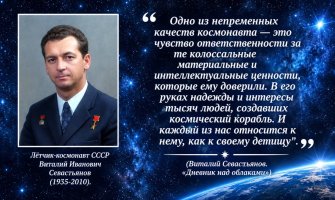
«Опасность в космосе при современных достижениях науки и техники — явление весьма редкостное. Хуже, когда космонавт-фантазер богатым воображением будет создавать различные варианты опасности...» — всегда вспоминал Петр Климук слова Виталия Севастьянова, мысленно соглашаясь, что космонавт в полете должен контактировать по связи с Землей, с человеческим коллективом, с родными и близкими. Где-то затерялись зеленый карандаш, лист бумаги. Опять, словно на легкой волне, покачивался у самого иллюминатора крохотный оловянный солдатик, будто и ему захотелось взглянуть с высоты на огромный шар Земли.
— Сообщение ТАСС! — радостно, даже заставив Петра Климука слегка вздрогнуть, воскликнул бортинженер, и командир, не отрываясь взглядом от солдатика, услыхал родной и близкий голос диктора московского радио:
— На 17 часов 30 минут московского времени космический корабль «Союз-13» совершил 18 оборотов вокруг Земли.
Космонавты Петр Ильич Климук и Валентин Витальевич Лебедев освоились с условиями невесомости и продолжают программу научно-технических исследований и экспериментов.
Вчера па пятом витке была проведена коррекция траектории полета, в результате которой корабль перешел на орбиту с параметрами:
—максимальное удаление от поверхности Земли (в апогее) — 272 километра;
— минимальное удаление от поверхности Земли (в перигее) — 225 километров;
— наклонение орбиты — 51,6 градуса;
— период обращения — 89,22 минуты.
Рабочий день экипажа начался в восемь часов утра. После медицинского контроля и завтрака Петр Климук и Валентин Лебедев приступили к выполнению программы второго дня полета. Проверив бортовые системы, они подготовили к работе и включили установку «Оазис-2», которая служит для исследований особенностей роста и культивирования отдельных биологических объектов в условиях невесомости. Затем космонавты начали расконсервацию системы телескопа «Орион-2». Согласно данным телеметрической информации и докладов командира корабля, полет проходит нормально».
Казалось бы, все до мелочей известно, и никакой Америки диктор открыть не мог, а космонавты до конца, слово в слово, прослушали сообщение. И как рукой сняло усталость, и радостно, легко стало на душе. И Петру Климуку зримо — протяни руку и попадешь в объятия — явилась мать, с повлажневшими глазами и напрасной настороженностью на изборожденном морщинками лице. И ему очень захотелось, чтоб отступил от ее сердца тяжкий камень, который, верно, давил на него с той самой минуты, как радио передало первое сообщение... Мать виделась и издали, и вблизи. Издали — когда расстояние от корабля до околицы Комаровки он пытался делить штрихами километров, когда в воображении вставали моря и океаны, степи и пустыни. И совсем близко, рядом,— когда, оторвавшись от иллюминатора, натыкался взглядом на оловянного солдатика и прикрывал веки...
И вызовы «Зари», и голос диктора радио, и воспоминания о матери навели на мысль: близкое, родное, земное предстает дорогими и отчетливыми картинами, когда ты взглядом и слухом налаживаешь связь с Землей, временно изолируешься от окружающего. В конце концов это и не его, Климука, открытие, он слышал об этом, приблизительно представлял себе, как это бывает, а вот пережил, перепроверил в душе впервые".(Н.В.Панасюк. "К созвездиям").
.............................................................
Цит.по: НИКОЛАЙ ВАСИЛЬЕВИЧ ПАНАСЮК
К СОЗВЕЗДИЯМ
Редактор В. М. Кизевич
Художественные редакторы Г. Г. Малышев,
Р. В. Кондрад
Технический редактор Я. С. Шляшинская
Корректор В. А. Скоробогатая
Минск/ Издательство "Беларусь"/ 1977 год.
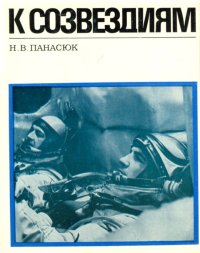
На фото титульный лист книги с рисунком художника В. П. Мастерова
“Pyotr Klimuk knew: for the purpose of preventing disturbances of mental functions it is very important to neutralize the negative effect of silence with an optimal sound background. The French speleologist Michel Siffre during a 63-day stay underground day after day delighted his hearing with recordings of various melodies, creating a corresponding mood and saving himself from loneliness. The navigator Alain Bombard in a solitary voyage, as the saying goes, bent over backwards so as not to grow wild from muteness, talked to a small doll as if it were a living being.
Another navigator with bated heart admired the beauties of nature, cheering himself with his own singing.
In outer space, beyond thrice-nine lands from people, among other things there are enough various surprises capable of spoiling a person’s mood, of causing an attack of despondency. One has only to think of the danger, and to fear is as close as from the nose to the chin. Say, a meteorite has pierced the wall of the ship. Depressurization of the compartment is half the trouble. But some red-hot metal fragment is like a bullet for the cosmonaut. This fragment, it turns out, is capable of hitting the electrical wiring as well. And since there is no lack of oxygen in the cabin — any spark will instantly set fire to the soft covering of the seats, the spacesuit…
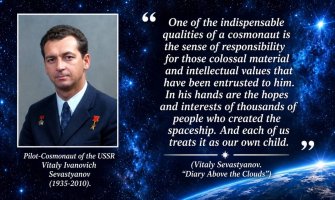
‘Danger in space with the present achievements of science and technology is a very rare phenomenon. It is worse when a cosmonaut-dreamer with a rich imagination creates various variants of danger…’ — Pyotr Klimuk always recalled the words of Vitaly Sevastyanov, mentally agreeing that a cosmonaut in flight must maintain contact by radio with the Earth, with the human collective, with relatives and close ones.
Somewhere a green pencil and a sheet of paper had got lost. Again, as if on a light wave, a tiny tin soldier was rocking right by the porthole, as if he too wanted to look from a height at the huge ball of the Earth.
— TASS report! — joyfully, even making Pyotr Klimuk start slightly, exclaimed the flight engineer, and the commander, without taking his eyes off the tin soldier, heard the native and close voice of the Moscow radio announcer:
— At 17 hours 30 minutes Moscow time the spaceship Soyuz-13 has completed 18 revolutions around the Earth.
Cosmonauts Pyotr Ilyich Klimuk and Valentin Vitalyevich Lebedev have adapted to the conditions of weightlessness and are continuing the programme of scientific-technical research and experiments.
Yesterday on the fifth orbit a correction of the flight trajectory was carried out, as a result of which the ship transferred to an orbit with the parameters:
— maximum distance from the Earth’s surface (at apogee) — 272 kilometres;
— minimum distance from the Earth’s surface (at perigee) — 225 kilometres;
— inclination of the orbit — 51.6 degrees;
— period of revolution — 89.22 minutes.
The working day of the crew began at eight o’clock in the morning. After medical control and breakfast Pyotr Klimuk and Valentin Lebedev proceeded to carry out the programme of the second day of the flight. Having checked the on-board systems, they prepared for work and switched on the ‘Oasis-2’ installation, which serves for research into the features of growth and cultivation of individual biological objects under conditions of weightlessness. Then the cosmonauts began the deconservation of the ‘Orion-2’ telescope system. According to the data of telemetric information and the reports of the ship’s commander, the flight is proceeding normally.
It would seem that everything is known down to the smallest details, and the announcer could not discover any America, yet the cosmonauts listened to the report to the end, word for word. And as if by magic the fatigue was removed, and it became joyful and light in the soul. And to Pyotr Klimuk, visually — stretch out your hand and you will fall into an embrace — appeared his mother, with moistened eyes and needless wariness on a face furrowed with wrinkles. And he very much wanted the heavy stone to retreat from her heart, which, surely, had been pressing on it from the very minute the radio transmitted the first report… His mother was seen both from afar and close by. From afar — when he tried to divide the distance from the ship to the outskirts of Komarovka with strokes of kilometres, when in his imagination seas and oceans, steppes and deserts rose up. And quite close, nearby — when, tearing himself away from the porthole, he encountered with his glance the tin soldier and closed his eyelids…
And the calls of ‘Zarya’, and the voice of the radio announcer, and the recollections of his mother led to the thought: the near, the native, the earthly appears in dear and distinct pictures when you establish a link with the Earth by sight and hearing, temporarily isolating yourself from the surrounding. In the end this is not even Klimuk’s discovery, he had heard about it, had approximately imagined how it happens, but he had experienced it, had rechecked it in his soul for the first time.”
(N. V. Panasyuk. “To the Constellations”).
.............................................................
Quoted from: NIKOLAI VASILYEVICH PANASYUK
TO THE CONSTELLATIONS
Editor V. M. Kizevich
Art editors G. G. Malyshev, R. V. Konrad
Technical editor Ya. S. Shlyashinskaya
Proof-reader V. A. Skorobogataya
Minsk / Publishing House “Belarus” / 1977
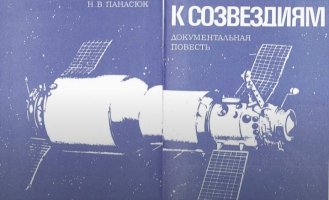
On the photo — the title page of the book with a drawing by the artist V. P. Masterov
“Piotr Klimuk sabía: con el fin de prevenir alteraciones de las funciones psíquicas es muy importante neutralizar el efecto negativo del silencio con un fondo sonoro óptimo. El espeleólogo francés Michel Siffre durante una estancia de 63 días bajo tierra día tras día deleitaba su oído con grabaciones de diversas melodías, creando el estado de ánimo correspondiente y salvándose de la soledad. El navegante Alain Bombard en una travesía solitaria, como se dice, se desvivía para no volverse salvaje por el mutismo, hablaba con una pequeña muñeca como si fuera un ser vivo.
Otro navegante con el corazón en suspenso admiraba las bellezas de la naturaleza, alegrándose con su propio canto.
En el espacio cósmico, a tres veces nueve tierras de la gente, entre otras cosas no faltan diversas sorpresas capaces de estropear el estado de ánimo de una persona, de provocar un ataque de abatimiento. Basta con pensar en el peligro, y hasta el miedo hay tan poco como de la nariz a la barbilla. Digamos que un meteorito ha perforado la pared de la nave. La despresurización del compartimento es media desgracia. Pero algún fragmento metálico al rojo vivo es como una bala para el cosmonauta. Este fragmento, resulta, es capaz de dar también en el cableado eléctrico. Y como en la cabina no falta oxígeno, cualquier chispa incendiará al instante el revestimiento blando de los asientos, el traje espacial…
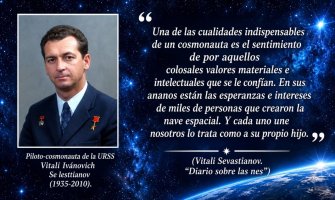
«El peligro en el cosmos con los actuales logros de la ciencia y la técnica es un fenómeno muy raro. Es peor cuando un cosmonauta soñador con una rica imaginación crea diversas variantes de peligro…» — siempre recordaba Piotr Klimuk las palabras de Vitali Sevastianov, coincidiendo mentalmente en que el cosmonauta en vuelo debe mantener contacto por radio con la Tierra, con el colectivo humano, con los familiares y allegados.
En algún sitio se habían perdido un lápiz verde y una hoja de papel. De nuevo, como sobre una ola ligera, se mecía junto al mismo ojo de buey un diminuto soldadito de plomo, como si también él quisiera mirar desde la altura la enorme bola de la Tierra.
— ¡Comunicado de la TASS! — exclamó alegremente, haciendo incluso que Piotr Klimuk se sobresaltara ligeramente, el ingeniero de vuelo, y el comandante, sin apartar la mirada del soldadito, oyó la voz nativa y cercana del locutor de la radio de Moscú:
— A las 17 horas 30 minutos hora de Moscú la nave espacial «Soyuz-13» ha completado 18 revoluciones alrededor de la Tierra.
Los cosmonautas Piotr Ilich Klimuk y Valentín Vitálievich Lébedev se han adaptado a las condiciones de la ingravidez y continúan el programa de investigaciones y experimentos científico-técnicos.
Ayer en la quinta órbita se realizó una corrección de la trayectoria de vuelo, como resultado de la cual la nave pasó a una órbita con los parámetros:
— distancia máxima de la superficie de la Tierra (en el apogeo) — 272 kilómetros;
— distancia mínima de la superficie de la Tierra (en el perigeo) — 225 kilómetros;
— inclinación de la órbita — 51,6 grados;
— período de revolución — 89,22 minutos.
La jornada laboral de la tripulación comenzó a las ocho de la mañana. Después del control médico y el desayuno Piotr Klimuk y Valentín Lébedev pasaron a cumplir el programa del segundo día de vuelo. Habiendo comprobado los sistemas de a bordo, prepararon para el trabajo y encendieron la instalación «Oasis-2», que sirve para investigar las peculiaridades del crecimiento y cultivo de determinados objetos biológicos en condiciones de ingravidez. Luego los cosmonautas comenzaron la desconservación del sistema del telescopio «Orión-2». Según los datos de la información telemétrica y los informes del comandante de la nave, el vuelo transcurre normalmente.
Parecería que todo se sabe hasta el más mínimo detalle, y el locutor no podía descubrir ninguna América, pero los cosmonautas escucharon el comunicado hasta el final, palabra por palabra. Y como por ensalmo se disipó el cansancio, y se hizo alegre y ligero en el alma. Y a Piotr Klimuk, de forma visible — tiende la mano y caerás en un abrazo —, se le apareció la madre, con los ojos humedecidos y una inútil cautela en el rostro surcado de arrugas. Y deseó mucho que se apartara de su corazón la pesada piedra que, sin duda, lo oprimía desde el mismo minuto en que la radio transmitió el primer comunicado… La madre se veía tanto de lejos como de cerca. De lejos — cuando intentaba dividir la distancia de la nave hasta las afueras de Komarovka con trazos de kilómetros, cuando en la imaginación surgían mares y océanos, estepas y desiertos. Y muy cerca, al lado — cuando, apartándose del ojo de buey, tropezaba con la mirada en el soldadito de plomo y cerraba los párpados…
Y las llamadas de «Zariá», y la voz del locutor de la radio, y los recuerdos de la madre llevaron a la idea: lo cercano, lo nativo, lo terrestre se presenta en cuadros queridos y nítidos cuando estableces un vínculo con la Tierra con la vista y el oído, aislándote temporalmente de lo circundante. Al fin y al cabo esto ni siquiera es un descubrimiento de Klimuk, él había oído hablar de ello, se lo había imaginado aproximadamente, pero lo experimentó, lo comprobó en su alma por primera vez.”
(N. V. Panasiuk. “Hacia las constelaciones”).
.............................................................
Citado de: NIKOLÁI VASÍLIEVICH PANASIUK
HACIA LAS CONSTELACIONES
Redactor V. M. Kizévich
Redactores artísticos G. G. Malyshev, R. V. Konrad
Redactor técnico Ya. S. Shliashínskaya
Correctora V. A. Skorobogátaya
Minsk / Editorial «Belarus» / 1977
En la foto — la página de título del libro con un dibujo del artista V. P. Masterov
«Опасность в космосе при современных достижениях науки и техники — явление весьма редкостное. Хуже, когда космонавт-фантазер богатым воображением будет создавать различные варианты опасности...» — всегда вспоминал Петр Климук слова Виталия Севастьянова, мысленно соглашаясь, что космонавт в полете должен контактировать по связи с Землей, с человеческим коллективом, с родными и близкими. Где-то затерялись зеленый карандаш, лист бумаги. Опять, словно на легкой волне, покачивался у самого иллюминатора крохотный оловянный солдатик, будто и ему захотелось взглянуть с высоты на огромный шар Земли.
— Сообщение ТАСС! — радостно, даже заставив Петра Климука слегка вздрогнуть, воскликнул бортинженер, и командир, не отрываясь взглядом от солдатика, услыхал родной и близкий голос диктора московского радио:
— На 17 часов 30 минут московского времени космический корабль «Союз-13» совершил 18 оборотов вокруг Земли.
Космонавты Петр Ильич Климук и Валентин Витальевич Лебедев освоились с условиями невесомости и продолжают программу научно-технических исследований и экспериментов.
Вчера па пятом витке была проведена коррекция траектории полета, в результате которой корабль перешел на орбиту с параметрами:
—максимальное удаление от поверхности Земли (в апогее) — 272 километра;
— минимальное удаление от поверхности Земли (в перигее) — 225 километров;
— наклонение орбиты — 51,6 градуса;
— период обращения — 89,22 минуты.
Рабочий день экипажа начался в восемь часов утра. После медицинского контроля и завтрака Петр Климук и Валентин Лебедев приступили к выполнению программы второго дня полета. Проверив бортовые системы, они подготовили к работе и включили установку «Оазис-2», которая служит для исследований особенностей роста и культивирования отдельных биологических объектов в условиях невесомости. Затем космонавты начали расконсервацию системы телескопа «Орион-2». Согласно данным телеметрической информации и докладов командира корабля, полет проходит нормально».
Казалось бы, все до мелочей известно, и никакой Америки диктор открыть не мог, а космонавты до конца, слово в слово, прослушали сообщение. И как рукой сняло усталость, и радостно, легко стало на душе. И Петру Климуку зримо — протяни руку и попадешь в объятия — явилась мать, с повлажневшими глазами и напрасной настороженностью на изборожденном морщинками лице. И ему очень захотелось, чтоб отступил от ее сердца тяжкий камень, который, верно, давил на него с той самой минуты, как радио передало первое сообщение... Мать виделась и издали, и вблизи. Издали — когда расстояние от корабля до околицы Комаровки он пытался делить штрихами километров, когда в воображении вставали моря и океаны, степи и пустыни. И совсем близко, рядом,— когда, оторвавшись от иллюминатора, натыкался взглядом на оловянного солдатика и прикрывал веки...
И вызовы «Зари», и голос диктора радио, и воспоминания о матери навели на мысль: близкое, родное, земное предстает дорогими и отчетливыми картинами, когда ты взглядом и слухом налаживаешь связь с Землей, временно изолируешься от окружающего. В конце концов это и не его, Климука, открытие, он слышал об этом, приблизительно представлял себе, как это бывает, а вот пережил, перепроверил в душе впервые".(Н.В.Панасюк. "К созвездиям").
.............................................................
Цит.по: НИКОЛАЙ ВАСИЛЬЕВИЧ ПАНАСЮК
К СОЗВЕЗДИЯМ
Редактор В. М. Кизевич
Художественные редакторы Г. Г. Малышев,
Р. В. Кондрад
Технический редактор Я. С. Шляшинская
Корректор В. А. Скоробогатая
Минск/ Издательство "Беларусь"/ 1977 год.
На фото титульный лист книги с рисунком художника В. П. Мастерова
“Pyotr Klimuk knew: for the purpose of preventing disturbances of mental functions it is very important to neutralize the negative effect of silence with an optimal sound background. The French speleologist Michel Siffre during a 63-day stay underground day after day delighted his hearing with recordings of various melodies, creating a corresponding mood and saving himself from loneliness. The navigator Alain Bombard in a solitary voyage, as the saying goes, bent over backwards so as not to grow wild from muteness, talked to a small doll as if it were a living being.
Another navigator with bated heart admired the beauties of nature, cheering himself with his own singing.
In outer space, beyond thrice-nine lands from people, among other things there are enough various surprises capable of spoiling a person’s mood, of causing an attack of despondency. One has only to think of the danger, and to fear is as close as from the nose to the chin. Say, a meteorite has pierced the wall of the ship. Depressurization of the compartment is half the trouble. But some red-hot metal fragment is like a bullet for the cosmonaut. This fragment, it turns out, is capable of hitting the electrical wiring as well. And since there is no lack of oxygen in the cabin — any spark will instantly set fire to the soft covering of the seats, the spacesuit…
‘Danger in space with the present achievements of science and technology is a very rare phenomenon. It is worse when a cosmonaut-dreamer with a rich imagination creates various variants of danger…’ — Pyotr Klimuk always recalled the words of Vitaly Sevastyanov, mentally agreeing that a cosmonaut in flight must maintain contact by radio with the Earth, with the human collective, with relatives and close ones.
Somewhere a green pencil and a sheet of paper had got lost. Again, as if on a light wave, a tiny tin soldier was rocking right by the porthole, as if he too wanted to look from a height at the huge ball of the Earth.
— TASS report! — joyfully, even making Pyotr Klimuk start slightly, exclaimed the flight engineer, and the commander, without taking his eyes off the tin soldier, heard the native and close voice of the Moscow radio announcer:
— At 17 hours 30 minutes Moscow time the spaceship Soyuz-13 has completed 18 revolutions around the Earth.
Cosmonauts Pyotr Ilyich Klimuk and Valentin Vitalyevich Lebedev have adapted to the conditions of weightlessness and are continuing the programme of scientific-technical research and experiments.
Yesterday on the fifth orbit a correction of the flight trajectory was carried out, as a result of which the ship transferred to an orbit with the parameters:
— maximum distance from the Earth’s surface (at apogee) — 272 kilometres;
— minimum distance from the Earth’s surface (at perigee) — 225 kilometres;
— inclination of the orbit — 51.6 degrees;
— period of revolution — 89.22 minutes.
The working day of the crew began at eight o’clock in the morning. After medical control and breakfast Pyotr Klimuk and Valentin Lebedev proceeded to carry out the programme of the second day of the flight. Having checked the on-board systems, they prepared for work and switched on the ‘Oasis-2’ installation, which serves for research into the features of growth and cultivation of individual biological objects under conditions of weightlessness. Then the cosmonauts began the deconservation of the ‘Orion-2’ telescope system. According to the data of telemetric information and the reports of the ship’s commander, the flight is proceeding normally.
It would seem that everything is known down to the smallest details, and the announcer could not discover any America, yet the cosmonauts listened to the report to the end, word for word. And as if by magic the fatigue was removed, and it became joyful and light in the soul. And to Pyotr Klimuk, visually — stretch out your hand and you will fall into an embrace — appeared his mother, with moistened eyes and needless wariness on a face furrowed with wrinkles. And he very much wanted the heavy stone to retreat from her heart, which, surely, had been pressing on it from the very minute the radio transmitted the first report… His mother was seen both from afar and close by. From afar — when he tried to divide the distance from the ship to the outskirts of Komarovka with strokes of kilometres, when in his imagination seas and oceans, steppes and deserts rose up. And quite close, nearby — when, tearing himself away from the porthole, he encountered with his glance the tin soldier and closed his eyelids…
And the calls of ‘Zarya’, and the voice of the radio announcer, and the recollections of his mother led to the thought: the near, the native, the earthly appears in dear and distinct pictures when you establish a link with the Earth by sight and hearing, temporarily isolating yourself from the surrounding. In the end this is not even Klimuk’s discovery, he had heard about it, had approximately imagined how it happens, but he had experienced it, had rechecked it in his soul for the first time.”
(N. V. Panasyuk. “To the Constellations”).
.............................................................
Quoted from: NIKOLAI VASILYEVICH PANASYUK
TO THE CONSTELLATIONS
Editor V. M. Kizevich
Art editors G. G. Malyshev, R. V. Konrad
Technical editor Ya. S. Shlyashinskaya
Proof-reader V. A. Skorobogataya
Minsk / Publishing House “Belarus” / 1977
On the photo — the title page of the book with a drawing by the artist V. P. Masterov
“Piotr Klimuk sabía: con el fin de prevenir alteraciones de las funciones psíquicas es muy importante neutralizar el efecto negativo del silencio con un fondo sonoro óptimo. El espeleólogo francés Michel Siffre durante una estancia de 63 días bajo tierra día tras día deleitaba su oído con grabaciones de diversas melodías, creando el estado de ánimo correspondiente y salvándose de la soledad. El navegante Alain Bombard en una travesía solitaria, como se dice, se desvivía para no volverse salvaje por el mutismo, hablaba con una pequeña muñeca como si fuera un ser vivo.
Otro navegante con el corazón en suspenso admiraba las bellezas de la naturaleza, alegrándose con su propio canto.
En el espacio cósmico, a tres veces nueve tierras de la gente, entre otras cosas no faltan diversas sorpresas capaces de estropear el estado de ánimo de una persona, de provocar un ataque de abatimiento. Basta con pensar en el peligro, y hasta el miedo hay tan poco como de la nariz a la barbilla. Digamos que un meteorito ha perforado la pared de la nave. La despresurización del compartimento es media desgracia. Pero algún fragmento metálico al rojo vivo es como una bala para el cosmonauta. Este fragmento, resulta, es capaz de dar también en el cableado eléctrico. Y como en la cabina no falta oxígeno, cualquier chispa incendiará al instante el revestimiento blando de los asientos, el traje espacial…
«El peligro en el cosmos con los actuales logros de la ciencia y la técnica es un fenómeno muy raro. Es peor cuando un cosmonauta soñador con una rica imaginación crea diversas variantes de peligro…» — siempre recordaba Piotr Klimuk las palabras de Vitali Sevastianov, coincidiendo mentalmente en que el cosmonauta en vuelo debe mantener contacto por radio con la Tierra, con el colectivo humano, con los familiares y allegados.
En algún sitio se habían perdido un lápiz verde y una hoja de papel. De nuevo, como sobre una ola ligera, se mecía junto al mismo ojo de buey un diminuto soldadito de plomo, como si también él quisiera mirar desde la altura la enorme bola de la Tierra.
— ¡Comunicado de la TASS! — exclamó alegremente, haciendo incluso que Piotr Klimuk se sobresaltara ligeramente, el ingeniero de vuelo, y el comandante, sin apartar la mirada del soldadito, oyó la voz nativa y cercana del locutor de la radio de Moscú:
— A las 17 horas 30 minutos hora de Moscú la nave espacial «Soyuz-13» ha completado 18 revoluciones alrededor de la Tierra.
Los cosmonautas Piotr Ilich Klimuk y Valentín Vitálievich Lébedev se han adaptado a las condiciones de la ingravidez y continúan el programa de investigaciones y experimentos científico-técnicos.
Ayer en la quinta órbita se realizó una corrección de la trayectoria de vuelo, como resultado de la cual la nave pasó a una órbita con los parámetros:
— distancia máxima de la superficie de la Tierra (en el apogeo) — 272 kilómetros;
— distancia mínima de la superficie de la Tierra (en el perigeo) — 225 kilómetros;
— inclinación de la órbita — 51,6 grados;
— período de revolución — 89,22 minutos.
La jornada laboral de la tripulación comenzó a las ocho de la mañana. Después del control médico y el desayuno Piotr Klimuk y Valentín Lébedev pasaron a cumplir el programa del segundo día de vuelo. Habiendo comprobado los sistemas de a bordo, prepararon para el trabajo y encendieron la instalación «Oasis-2», que sirve para investigar las peculiaridades del crecimiento y cultivo de determinados objetos biológicos en condiciones de ingravidez. Luego los cosmonautas comenzaron la desconservación del sistema del telescopio «Orión-2». Según los datos de la información telemétrica y los informes del comandante de la nave, el vuelo transcurre normalmente.
Parecería que todo se sabe hasta el más mínimo detalle, y el locutor no podía descubrir ninguna América, pero los cosmonautas escucharon el comunicado hasta el final, palabra por palabra. Y como por ensalmo se disipó el cansancio, y se hizo alegre y ligero en el alma. Y a Piotr Klimuk, de forma visible — tiende la mano y caerás en un abrazo —, se le apareció la madre, con los ojos humedecidos y una inútil cautela en el rostro surcado de arrugas. Y deseó mucho que se apartara de su corazón la pesada piedra que, sin duda, lo oprimía desde el mismo minuto en que la radio transmitió el primer comunicado… La madre se veía tanto de lejos como de cerca. De lejos — cuando intentaba dividir la distancia de la nave hasta las afueras de Komarovka con trazos de kilómetros, cuando en la imaginación surgían mares y océanos, estepas y desiertos. Y muy cerca, al lado — cuando, apartándose del ojo de buey, tropezaba con la mirada en el soldadito de plomo y cerraba los párpados…
Y las llamadas de «Zariá», y la voz del locutor de la radio, y los recuerdos de la madre llevaron a la idea: lo cercano, lo nativo, lo terrestre se presenta en cuadros queridos y nítidos cuando estableces un vínculo con la Tierra con la vista y el oído, aislándote temporalmente de lo circundante. Al fin y al cabo esto ni siquiera es un descubrimiento de Klimuk, él había oído hablar de ello, se lo había imaginado aproximadamente, pero lo experimentó, lo comprobó en su alma por primera vez.”
(N. V. Panasiuk. “Hacia las constelaciones”).
.............................................................
Citado de: NIKOLÁI VASÍLIEVICH PANASIUK
HACIA LAS CONSTELACIONES
Redactor V. M. Kizévich
Redactores artísticos G. G. Malyshev, R. V. Konrad
Redactor técnico Ya. S. Shliashínskaya
Correctora V. A. Skorobogátaya
Minsk / Editorial «Belarus» / 1977
En la foto — la página de título del libro con un dibujo del artista V. P. Masterov