- Thread starter
- #1,101

Frimen1917
Mecca V.I.P.
VIP
- Joined
- Jan 9, 2026
- Messages
- 3,349
- Points
- 63
Журнал "Земля и Вселенная"; №3; 1966.
ПЕРВЫЙ В МИРЕ ИСКУССТВЕННЫЙ СПУТНИК ЛУНЫ
3 апреля 1966 года в 21 час 44 минуты по московскому времени автоматическая станция «Луна-10» была выведена на селеноцентрическую (окололунную) орбиту с параметрами: в периселении удаление спутника от поверхности Луны — 350 км, в апоселении — 1017 км; период обращения вокруг Луны 2 часа 58 мин. 15 сек.; угол наклонения орбиты спутника к плоскости лунного экватора 71°54′.
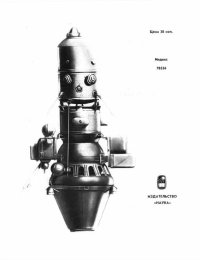
Автоматическая станция «Луна-10» (см. рисунок на четвертой странице обложки) состоит из двух основных частей: искусственного спутника Луны и двигательной установки с приборными отсеками. Искусственный спутник Луны — герметичный контейнер весом 245 кг, в котором установлена следующая научная аппаратура:
трехкомпонентный магнитометр для уточнения нижнего предела возможного магнитного поля Луны;
гамма-спектрометр для исследования интенсивности и спектрального состава гамма-излучения поверхности Луны;
счетчики для регистрации солнечного корпускулярного и космического излучения, а также для исследования мягких электронов с целью обнаружения ионосферы Луны и изучения заряженных частиц «хвоста» магнитосферы Земли у орбиты Луны;
ионные ловушки для регистрации полного потока ионов и электронов солнечного ветра и поиска ионосферы Луны;
пьезоэлектрические датчики для регистрации в межпланетном и окололунном пространстве метеорных частиц с массой, превышающей одну стомиллионную грамма; инфракрасный датчик для определения интегрального теплового излучения Луны; счетчики мягких рентгеновских фотонов для измерения рентгеновского флюоресцентного излучения пород лунной поверхности.
После выхода автоматической станции на окололунную орбиту искусственный спутник Луны был отделен от двигательной установки и начал проводить научные исследования.
По данным телеметрии, бортовая аппаратура спутника работает нормально. Получены и обрабатываются ценные данные, представляющие важный вклад в исследования физических свойств Луны и окололунного пространства.
Полупроводниковый электронный генератор, излучающий в определенной последовательности электрические колебания семи частот (1666,7; 1785,7; 2000; 2173,9; 2500; 2631,6 и 2941,2 герц), неоднократно передавал с борта спутника часть мелодии «Интернационала».
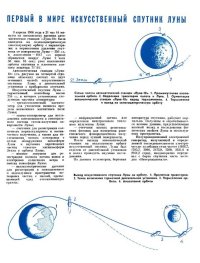
На фото страница журнала "Земля и Вселенная" со схемами полета автоматической станции "Луна-10".
Magazine “The Earth and the Universe”; No. 3; 1966.
THE WORLD’S FIRST ARTIFICIAL SATELLITE OF THE MOON
On April 3, 1966, at 21:44 Moscow time, the automatic station Luna 10 was placed into a selenocentric (lunar) orbit with the following parameters: at perilune, the satellite was 350 km above the lunar surface; at apolune, 1,017 km; the orbital period around the Moon was 2 hours, 58 minutes and 15 seconds; the inclination of the satellite’s orbit to the plane of the lunar equator was 71°54′.
The automatic station Luna 10 (see the illustration on the fourth page of the cover) consists of two main parts: the artificial satellite of the Moon and a propulsion unit with instrument compartments. The artificial satellite of the Moon is a sealed container weighing 245 kg, equipped with the following scientific instruments:
- A three-component magnetometer to determine more precisely the lower limit of the possible magnetic field of the Moon;
- A gamma-ray spectrometer to study the intensity and spectral composition of gamma radiation from the lunar surface;
- Particle counters to detect solar corpuscular and cosmic radiation, as well as to study low-energy electrons in order to detect a lunar ionosphere and investigate charged particles in the “tail” of Earth’s magnetosphere near the Moon’s orbit;
- Ion traps to record the total flux of solar-wind ions and electrons and to search for a lunar ionosphere;
- Piezoelectric sensors to detect, in interplanetary and circumlunar space, meteoroid particles with masses exceeding one hundred-millionth of a gram;
- An infrared sensor to determine the total thermal radiation of the Moon;
- Soft X-ray photon counters to measure the X-ray fluorescence emitted by rocks on the lunar surface.
After the automatic station entered lunar orbit, the artificial satellite of the Moon separated from the propulsion unit and began conducting scientific research.
According to telemetry data, the satellite’s onboard equipment is functioning normally. Valuable data have been received and are being processed, representing an important contribution to the study of the physical properties of the Moon and the space around it.
A semiconductor electronic generator, which emits electrical oscillations at seven frequencies in a specific sequence (1666.7; 1785.7; 2000; 2173.9; 2500; 2631.6 and 2941.2 hertz), repeatedly transmitted part of the melody of “The Internationale” from the satellite.
The photograph shows a page from the magazine “The Earth and the Universe” featuring diagrams of the flight of the automatic station Luna 10.
Revista «La Tierra y el Universo»; n.º 3; 1966.
# EL PRIMER SATÉLITE ARTIFICIAL DE LA LUNA DEL MUNDO
El 3 de abril de 1966, a las 21:44, hora de Moscú, la estación automática Luna 10 fue situada en una órbita selenocéntrica (alrededor de la Luna) con los siguientes parámetros: en el perilunio, la distancia del satélite a la superficie lunar era de 350 km; en el apolunio, de 1.017 km; el período de revolución alrededor de la Luna era de 2 horas, 58 minutos y 15 segundos; la inclinación de la órbita del satélite respecto al plano del ecuador lunar era de 71°54′.
La estación automática Luna 10 (véase la ilustración en la cuarta página de la cubierta) consta de dos partes principales: el satélite artificial de la Luna y una unidad propulsora con compartimentos para los instrumentos. El satélite artificial de la Luna es un contenedor hermético de 245 kg de peso, equipado con los siguientes instrumentos científicos:
- Un magnetómetro de tres componentes para precisar el límite inferior del posible campo magnético de la Luna;
- Un espectrómetro de rayos gamma para estudiar la intensidad y la composición espectral de la radiación gamma procedente de la superficie lunar;
- Contadores para registrar la radiación corpuscular solar y la radiación cósmica, así como para estudiar los electrones de baja energía con el fin de detectar la ionosfera lunar e investigar las partículas cargadas de la «cola» de la magnetosfera terrestre en las proximidades de la órbita lunar;
- Trampas de iones para registrar el flujo total de iones y electrones del viento solar y buscar la ionosfera lunar;
- Sensores piezoeléctricos para registrar, en el espacio interplanetario y en las proximidades de la Luna, partículas meteóricas con una masa superior a una cienmillonésima de gramo;
- Un sensor infrarrojo para determinar la radiación térmica total de la Luna;
- Contadores de fotones de rayos X blandos para medir la radiación fluorescente de rayos X emitida por las rocas de la superficie lunar.
Después de que la estación automática alcanzara la órbita lunar, el satélite artificial de la Luna se separó de la unidad propulsora y comenzó a realizar investigaciones científicas.
Según los datos de telemetría, los equipos de a bordo del satélite funcionan con normalidad. Se han recibido y se están procesando valiosos datos que constituyen una importante contribución al estudio de las propiedades físicas de la Luna y del espacio que la rodea.
Un generador electrónico semiconductor, que emite oscilaciones eléctricas en una secuencia determinada de siete frecuencias (1666,7; 1785,7; 2000; 2173,9; 2500; 2631,6 y 2941,2 hercios), transmitió repetidamente desde el satélite una parte de la melodía de «La Internacional».
En la fotografía aparece una página de la revista «La Tierra y el Universo» con esquemas del vuelo de la estación automática Luna 10.
ПЕРВЫЙ В МИРЕ ИСКУССТВЕННЫЙ СПУТНИК ЛУНЫ
3 апреля 1966 года в 21 час 44 минуты по московскому времени автоматическая станция «Луна-10» была выведена на селеноцентрическую (окололунную) орбиту с параметрами: в периселении удаление спутника от поверхности Луны — 350 км, в апоселении — 1017 км; период обращения вокруг Луны 2 часа 58 мин. 15 сек.; угол наклонения орбиты спутника к плоскости лунного экватора 71°54′.
Автоматическая станция «Луна-10» (см. рисунок на четвертой странице обложки) состоит из двух основных частей: искусственного спутника Луны и двигательной установки с приборными отсеками. Искусственный спутник Луны — герметичный контейнер весом 245 кг, в котором установлена следующая научная аппаратура:
трехкомпонентный магнитометр для уточнения нижнего предела возможного магнитного поля Луны;
гамма-спектрометр для исследования интенсивности и спектрального состава гамма-излучения поверхности Луны;
счетчики для регистрации солнечного корпускулярного и космического излучения, а также для исследования мягких электронов с целью обнаружения ионосферы Луны и изучения заряженных частиц «хвоста» магнитосферы Земли у орбиты Луны;
ионные ловушки для регистрации полного потока ионов и электронов солнечного ветра и поиска ионосферы Луны;
пьезоэлектрические датчики для регистрации в межпланетном и окололунном пространстве метеорных частиц с массой, превышающей одну стомиллионную грамма; инфракрасный датчик для определения интегрального теплового излучения Луны; счетчики мягких рентгеновских фотонов для измерения рентгеновского флюоресцентного излучения пород лунной поверхности.
После выхода автоматической станции на окололунную орбиту искусственный спутник Луны был отделен от двигательной установки и начал проводить научные исследования.
По данным телеметрии, бортовая аппаратура спутника работает нормально. Получены и обрабатываются ценные данные, представляющие важный вклад в исследования физических свойств Луны и окололунного пространства.
Полупроводниковый электронный генератор, излучающий в определенной последовательности электрические колебания семи частот (1666,7; 1785,7; 2000; 2173,9; 2500; 2631,6 и 2941,2 герц), неоднократно передавал с борта спутника часть мелодии «Интернационала».
На фото страница журнала "Земля и Вселенная" со схемами полета автоматической станции "Луна-10".
Magazine “The Earth and the Universe”; No. 3; 1966.
THE WORLD’S FIRST ARTIFICIAL SATELLITE OF THE MOON
On April 3, 1966, at 21:44 Moscow time, the automatic station Luna 10 was placed into a selenocentric (lunar) orbit with the following parameters: at perilune, the satellite was 350 km above the lunar surface; at apolune, 1,017 km; the orbital period around the Moon was 2 hours, 58 minutes and 15 seconds; the inclination of the satellite’s orbit to the plane of the lunar equator was 71°54′.
The automatic station Luna 10 (see the illustration on the fourth page of the cover) consists of two main parts: the artificial satellite of the Moon and a propulsion unit with instrument compartments. The artificial satellite of the Moon is a sealed container weighing 245 kg, equipped with the following scientific instruments:
- A three-component magnetometer to determine more precisely the lower limit of the possible magnetic field of the Moon;
- A gamma-ray spectrometer to study the intensity and spectral composition of gamma radiation from the lunar surface;
- Particle counters to detect solar corpuscular and cosmic radiation, as well as to study low-energy electrons in order to detect a lunar ionosphere and investigate charged particles in the “tail” of Earth’s magnetosphere near the Moon’s orbit;
- Ion traps to record the total flux of solar-wind ions and electrons and to search for a lunar ionosphere;
- Piezoelectric sensors to detect, in interplanetary and circumlunar space, meteoroid particles with masses exceeding one hundred-millionth of a gram;
- An infrared sensor to determine the total thermal radiation of the Moon;
- Soft X-ray photon counters to measure the X-ray fluorescence emitted by rocks on the lunar surface.
After the automatic station entered lunar orbit, the artificial satellite of the Moon separated from the propulsion unit and began conducting scientific research.
According to telemetry data, the satellite’s onboard equipment is functioning normally. Valuable data have been received and are being processed, representing an important contribution to the study of the physical properties of the Moon and the space around it.
A semiconductor electronic generator, which emits electrical oscillations at seven frequencies in a specific sequence (1666.7; 1785.7; 2000; 2173.9; 2500; 2631.6 and 2941.2 hertz), repeatedly transmitted part of the melody of “The Internationale” from the satellite.
The photograph shows a page from the magazine “The Earth and the Universe” featuring diagrams of the flight of the automatic station Luna 10.
Revista «La Tierra y el Universo»; n.º 3; 1966.
# EL PRIMER SATÉLITE ARTIFICIAL DE LA LUNA DEL MUNDO
El 3 de abril de 1966, a las 21:44, hora de Moscú, la estación automática Luna 10 fue situada en una órbita selenocéntrica (alrededor de la Luna) con los siguientes parámetros: en el perilunio, la distancia del satélite a la superficie lunar era de 350 km; en el apolunio, de 1.017 km; el período de revolución alrededor de la Luna era de 2 horas, 58 minutos y 15 segundos; la inclinación de la órbita del satélite respecto al plano del ecuador lunar era de 71°54′.
La estación automática Luna 10 (véase la ilustración en la cuarta página de la cubierta) consta de dos partes principales: el satélite artificial de la Luna y una unidad propulsora con compartimentos para los instrumentos. El satélite artificial de la Luna es un contenedor hermético de 245 kg de peso, equipado con los siguientes instrumentos científicos:
- Un magnetómetro de tres componentes para precisar el límite inferior del posible campo magnético de la Luna;
- Un espectrómetro de rayos gamma para estudiar la intensidad y la composición espectral de la radiación gamma procedente de la superficie lunar;
- Contadores para registrar la radiación corpuscular solar y la radiación cósmica, así como para estudiar los electrones de baja energía con el fin de detectar la ionosfera lunar e investigar las partículas cargadas de la «cola» de la magnetosfera terrestre en las proximidades de la órbita lunar;
- Trampas de iones para registrar el flujo total de iones y electrones del viento solar y buscar la ionosfera lunar;
- Sensores piezoeléctricos para registrar, en el espacio interplanetario y en las proximidades de la Luna, partículas meteóricas con una masa superior a una cienmillonésima de gramo;
- Un sensor infrarrojo para determinar la radiación térmica total de la Luna;
- Contadores de fotones de rayos X blandos para medir la radiación fluorescente de rayos X emitida por las rocas de la superficie lunar.
Después de que la estación automática alcanzara la órbita lunar, el satélite artificial de la Luna se separó de la unidad propulsora y comenzó a realizar investigaciones científicas.
Según los datos de telemetría, los equipos de a bordo del satélite funcionan con normalidad. Se han recibido y se están procesando valiosos datos que constituyen una importante contribución al estudio de las propiedades físicas de la Luna y del espacio que la rodea.
Un generador electrónico semiconductor, que emite oscilaciones eléctricas en una secuencia determinada de siete frecuencias (1666,7; 1785,7; 2000; 2173,9; 2500; 2631,6 y 2941,2 hercios), transmitió repetidamente desde el satélite una parte de la melodía de «La Internacional».
En la fotografía aparece una página de la revista «La Tierra y el Universo» con esquemas del vuelo de la estación automática Luna 10.