










WaveRider
Active member
Member
- Joined
- Jul 15, 2008
- Messages
- 30
- Points
- 6

With Sleeping 8 Hours or More
Although it’s a common belief that 8 hours of sleep is required for optimal health, a six-year study of more than one million adults ages 30 to 102 has shown that people who get only 6 to 7 hours a night have a lower death rate. Individuals who sleep 8 hours or more, or less than 4 hours a night, were shown to have a significantly increased death rate compared to those who averaged 6 to 7 hours.
Researchers from the University of California, San Diego (UCSD) School of Medicine and the American Cancer Society collaborated on the study, which appeared in the February 15, 2002 issue of the Archives of General Psychiatry, a journal of the American Medical Association.
Although the data indicated the highest mortality rates with long-duration sleep, the study could not explain the causes or reasons for this association.
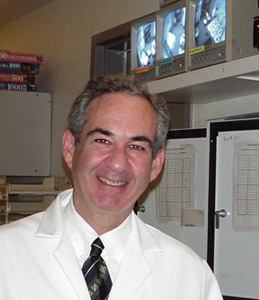
Daniel F. Kripke, M.D., in his sleep lab at UCSD.
First author Daniel F. Kripke, M.D., a UCSD professor of psychiatry who specializes in sleep research, said “we don’t know if long sleep periods lead to death. Additional studies are needed to determine if setting your alarm clock earlier will actually improve your health.”
But, he added “individuals who now average 6.5 hours of sleep a night, can be reassured that this is a safe amount of sleep. From a health standpoint, there is no reason to sleep longer.”
Kripke is also a member of UCSD's Sam and Rose Stein Institute for Research on Aging.
The study, which addressed sleep issues as part of the Cancer Prevention Study II (CPSII) of the American Cancer Society, also indicated that participants who reported occasional bouts of insomnia did not have an increased mortality rate, but those individuals who took sleeping pills were more likely to die sooner.
“Insomnia is not synonymous with short sleep,” the authors said in the article. “Patients commonly complain of insomnia when their sleep durations are well within the range of people without sleep symptoms.”
They added that physicians believe most patient complaints about “insomnia” are actually related to depression, rather than a diagnosis of insomnia.
With 1.1 million participants, this was the first large-scale population study of sleep to also take into consideration variables such as age, diet, exercise, previous health problems, and risk factors such as smoking, in comparing longevity among the participants. In other words, individuals with specific characteristics were compared with individuals of a similar age, health background, etc.
Although the study was conducted from 1982-88, the sleep results have not been available until recently due to the length of time required to input and analyze the vast amount and variety of data from the 1.1 million participants.
“Previous sleep studies have indicated that both short- and long-duration sleep had higher mortality rates,” Kripke said. “However, none of those studies were large enough to distinguish the difference between 7 and 8 hours a night, until now.”
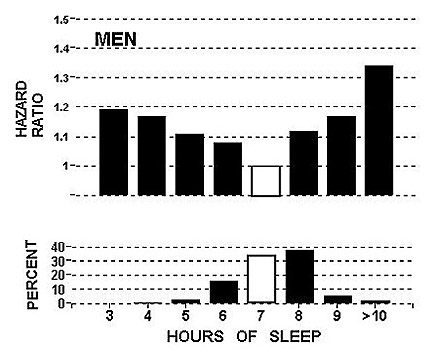
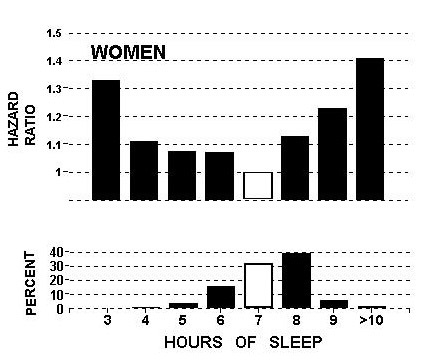
The figures above indicate hours of sleep for men (left) and women (right). The hazard ratio, the top bar graph, indicates the mortality risk while the bottom graph shows the percentage of subjects associated with the reported number of hours sleep.
The best survival rates were found among those who slept 7 hours per night. The study showed that a group sleeping 8 hours were 12 percent more likely to die within the six-year period than those sleeping 7 hours, other factors being equal. Even those with as little as 5 hours sleep lived longer than participants with 8 hours or more per night.
The mean age for women in the study was 57, while the mean age for men was 58. Within the six year period, 5.1 percent of the women had died and 9.4 percent of the men. The causes of death resembled the distribution for the general population.
Additional authors of the study were Lawrence Garfinkel, M.A., the American Cancer Society, New York; Deborah L. Wingard, Ph.D. and Melville R. Klauber, Ph.D., UCSD Department of Family and Preventive Medicine; and Matthew R. Marler, Ph.D., UCSD Department of Psychiatry.
Data came from the American Cancer Society with analysis supported by the National Institutes of Health.
# # #
Media Contact:
Sue Pondrom
[email protected]
619-543-6163
Links to printable versions of photos and graphs:
Photos of Dr. Kripke - Kripke 1 Kripke 2
Graph images = Men or Women
More sleep information from Dr. Kripke- booklets in PDF format:
The Dark Side of Sleeping Pills
Brighten Your Life - bright light treatment
UCSD Health Sciences Communications HealthBeat: http://health.ucsd.edu/news/






