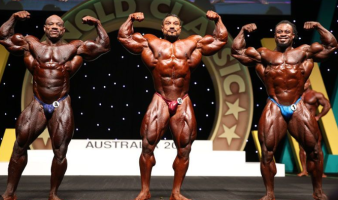
You don't need a massive population to dominate bodybuilding. You need intensity, lifestyle, and culture. Australia's outdoor lifestyle builds raw athleticism early, while coaches prioritize hard, focused training over sheer volume. Legends like Lee Priest and Bev Francis proved Aussie talent on the world stage, and hosting the 1980 Mr. Olympia cemented that legacy. Today's emerging athletes in Perth, Melbourne, and Gold Coast are carrying it forward.

That same philosophy still shapes Australian bodybuilding gyms today, where coaches emphasize compound lifts, controlled tempo, and pushing sets closer to failure. It's a training style that's produced several Australian pro bodybuilders known for dense, hard physiques rather than sheer training volume.
If you train this way, you'll understand why bodybuilding in Australia values quality over quantity every time.

This mix of famous Australian bodybuilders, multiple federations like IFBB, INBA, and NABBA, and a culture built on hard training answers why Australia produces bodybuilders who compete far beyond their home turf.
Established federations, experienced local coaches, and international travel opportunities give you a clearer path from amateur shows to pro stages than existed decades ago. That pipeline is why Australia keeps producing credible Olympia contenders instead of one-off standouts.

The Aussie Bodybuilders Dominating the Olympia Stage
Because Australia sits far from bodybuilding's traditional power centers in America and Europe, you'd expect its athletes to struggle for recognition on the Olympia stage. Yet Australian bodybuilding has repeatedly punched through that barrier, proving distance isn't destiny. Lee Priest stands as the clearest example, trading early wins in Australian bodybuilding competitions for a full IFBB pro career and multiple Olympia appearances. You can see how his aggressive mass and conditioning translated directly to American stages, giving Australian bodybuilders a genuine foothold in professional competition. His success showed that talent developed in Australian gyms could compete at the sport's highest level. Priest's Olympia runs effectively put Australia on bodybuilding's global map for good.Why Australia's Outdoor Lifestyle Builds Elite Physiques
Priest and his Olympia peers came out of a broader Australian lifestyle that favors sun, surf, and outdoor activity year-round. You'll find that Australian fitness culture doesn't separate training from everyday movement; beach workouts, swimming, and outdoor sports build the kind of baseline conditioning that translates well into the weight room. This environment gave athletes like Bev Francis a foundation of raw athleticism before she ever stepped into bodybuilding gyms. That same outdoor-driven discipline still feeds both natural bodybuilding and professional bodybuilding pathways today. You're looking at a culture where physical activity is a lifestyle, not a chore, and that mindset naturally produces competitors who train harder and recover smarter.Why Aussie Coaches Train Harder, Not Longer
When you look at how Australian coaches structure training, you'll notice a preference for intensity over volume. Instead of stacking hours in the gym, they push you to make every set count, a mindset rooted deep in Australian bodybuilding culture. This approach traces back to the early Mr. Australia era, when access to limited equipment forced lifters to focus on effort rather than endless variety.That same philosophy still shapes Australian bodybuilding gyms today, where coaches emphasize compound lifts, controlled tempo, and pushing sets closer to failure. It's a training style that's produced several Australian pro bodybuilders known for dense, hard physiques rather than sheer training volume.
If you train this way, you'll understand why bodybuilding in Australia values quality over quantity every time.

How Australia's Bodybuilding Industry Built Global Influence
You can trace Australia's bodybuilding history back to the 1947 Mr. Australia contest, but the real global leap came when athletes started competing abroad. Lee Priest's IFBB pro career put the Australian bodybuilding scene on American stages, while Bev Francis reshaped conversations about women's bodybuilding worldwide. Hosting the 1980 Mr. Olympia at the Sydney Opera House proved Australia could sit at the center of the sport, not just its periphery.This mix of famous Australian bodybuilders, multiple federations like IFBB, INBA, and NABBA, and a culture built on hard training answers why Australia produces bodybuilders who compete far beyond their home turf.
The Next Wave of Aussie Olympia Contenders
Since Priest and Francis proved Australians could stand toe-to-toe with the world's best, a new generation has been quietly building the resumes to follow them onto the Olympia stage. You'll find them training in Perth, Melbourne, and the Gold Coast, chasing IFBB Pro cards through regional qualifiers before testing themselves against American and European fields. They're combining the compound-lifting foundation of Australia's gym culture with modern coaching, nutrition science, and social media exposure that Priest's generation never had access to.Established federations, experienced local coaches, and international travel opportunities give you a clearer path from amateur shows to pro stages than existed decades ago. That pipeline is why Australia keeps producing credible Olympia contenders instead of one-off standouts.