Frimen1917
Mecca V.I.P.
VIP
- Joined
- Jan 9, 2026
- Messages
- 3,270
- Points
- 63
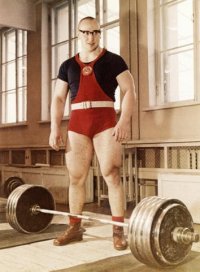
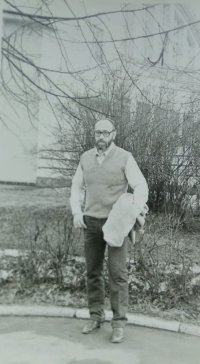
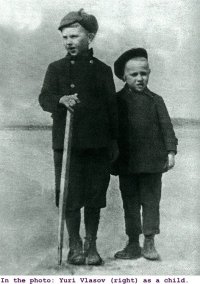
Yury Petrovich Vlasov

Born on December 5, 1935, in Makeevka, Donetsk Region — died on February 13, 2021, in Moscow.
Yury Petrovich Vlasov was a Soviet weightlifter, Olympic champion (1960), four-time World Champion (1959, 1961, 1962, 1963), and six-time European Champion (1959–1964). He was awarded the title of Honored Master of Sports of the USSR in 1959. Vlasov served as the flag bearer of the Soviet delegation at the opening ceremonies of the Olympic Games in 1960 and 1964. He was also a writer, public and political figure, a People’s Deputy of the USSR (1989–1991), and a Deputy of the State Duma of the Russian Federation (1993–1995).
Early Life and Education
Yury Vlasov was born on December 5, 1935, in Makeevka, Donetsk Region.
His father, Pyotr Parfenovich Vlasov (also known as Vladimirov) (1905–1953), was an intelligence officer, journalist, and diplomat, a specialist on China. His mother, Maria Danilovna Vlasova (died in 1987), was a native of the Kuban region and worked as a library director.
His childhood fell during the years of World War II. In 1943, at the age of eight, he lost his hair due to starvation.

From an early age, he actively engaged in sports. In 1953, he graduated with honors from the Saratov Suvorov Military School. In 1959, he graduated from the Zhukovsky Air Force Engineering Academy in Moscow, specializing in aviation radio communications engineering. Upon graduation, he was commissioned as a Senior Lieutenant.
From 1960 to 1968, Vlasov served as a sports inspector at CSKA (Central Sports Club of the Army). In May 1968, he submitted a request for discharge from military service and was released with the rank of Captain.
Athletic Career
In the spring of 1957, Vlasov set his first USSR records in the snatch (144.5 kg) and the clean and jerk (183.0 kg), hookup leading with Alexey Medvedev at the time. In 1958, he placed third at the USSR Championship (total 470 kg), and by 1959 he had taken leadership in the heavyweight category. From then until the 1964 Olympic Games, he remained undefeated in competitions.
At the 1960 Olympic Games in Rome, Vlasov pressed 180 kg (matching American James Bradford, who later won silver), snatched 155 kg (outperforming his closest rivals by 5 kg), and clean and jerked 202.5 kg, achieving a total of 537.5 kg. Bradford lagged behind by 20 kg in the clean and jerk and by 25 kg in total.

Vlasov began his final lift after all competitors had finished. His first attempt of 185 kg secured Olympic gold and set a world record in the total (520 kg), surpassing the previous record held since 1955 by American Paul Anderson. The second attempt at 195 kg raised the world record total to 530 kg. The third attempt at 202.5 kg established a new world record, bringing the final total to 537.5 kg — exceeding both Anderson’s official (512.5 kg) and unofficial (533 kg) achievements from 1956.
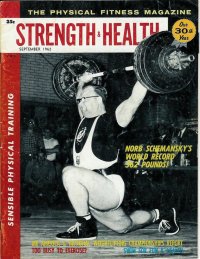
Between 1959 and 1963, Vlasov’s main international rivals were American athletes, especially Norbert Schemansky. Despite his age (born in 1924), Schemansky twice took world records from Vlasov in the snatch (1961, 1962) and twice placed second at World Championships (1962, 1963). Their rivalry peaked at the 1962 World Championship, where Schemansky lost by only 2.5 kg, despite winning the press and the snatch.

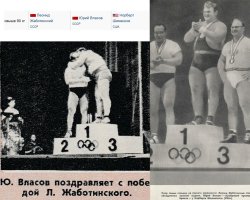
At the 1964 Olympic Games in Tokyo, Vlasov was the favorite. His main rival was teammate Leonid Zhabotinsky, who had set world records in the snatch, clean and jerk, and total earlier that year (records which Vlasov later reclaimed). Zhabotinsky outweighed Vlasov (154.4 kg vs. 136.4 kg), so in case of equal results, Vlasov would have won.
Vlasov won the press with a world record of 197.5 kg, leading by 10 kg. In the snatch, he lifted 162.5 kg only on his third attempt, allowing Zhabotinsky to close the gap to 5 kg. Unexpectedly, Vlasov attempted a fourth, non-scoring lift, setting a world record at 172.5 kg.
In the clean and jerk, Zhabotinsky lifted 200 kg; Vlasov responded with 205 kg and then 210 kg. The bar was raised above the world record to 217.5 kg. Zhabotinsky failed his second attempt (many later believed intentionally), Vlasov failed his third, but Zhabotinsky succeeded on his final attempt and won Olympic gold.

After the Tokyo Games, Vlasov ceased intensive training but resumed in 1966 due to financial difficulties. On April 15, 1967, he set his final world record at the Moscow Championship. He officially retired from elite sport in 1968. Between 1957 and 1967, Vlasov set 31 world records and 41 USSR records.
Struggle with Illness
In 1960, during a competition in Lviv, Vlasov felt a crunch and sharp pain in his lower spine while attempting to hold a heavy weight. In the spring of 1964, he suffered a series of severe colds with high fever. By 1969, his weight dropped to 110 kg (from a competitive 136.4 kg).
By the late 1960s, he experienced cardiac arrhythmia, headaches, shortness of breath, fatigue, and dangerously low blood pressure. From 1970 onward, he suffered frequent influenza, bleeding gums, spinal pain, liver pain, and chills. Doctors diagnosed him with gallbladder inflammation in 1970.
In his writings, Vlasov concluded that the root cause of his illness was nervous system exhaustion and believed recovery required absolute faith in the treatment method. He experimented with cold hardening following the method of German pastor Sebastian Kneipp, fasting according to Paul Bragg’s diet, and other extreme measures — many of which worsened his condition.
On February 21, 1983, he was hospitalized with acute spinal pain. Surgeons removed an intervertebral disc and inserted a 20-centimeter stainless steel fixation plate. Doctors forbade him even to sit. Nevertheless, Vlasov gradually resumed training with dumbbells — first lying down, then sitting and standing — combined with psychological self-training.
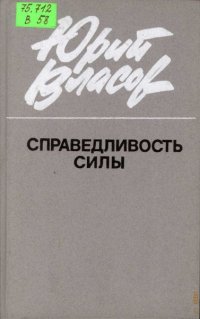
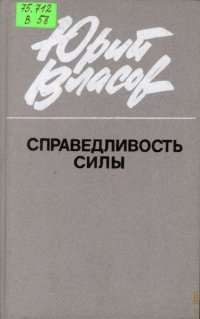
In Vlasov’s book “The Justice of Strength”, there is a photograph of Arnold Schwarzenegger with the inscription:
“To my idol, Yury Vlasov. March 1988.”

Schwarzenegger explained that meeting Vlasov at the 1961 World Championship in Vienna inspired him to commit himself fiercely to training. That brief encounter with “the strongest man in the world” helped shape the future seven-time Mr. Olympia, film star, and politician.
Literary Work
Vlasov began publishing essays and short stories in 1959. In 1961, he won second prize in a national sports short story competition. At the 1962 World Championship, he also worked as a special correspondent for Izvestia newspaper.
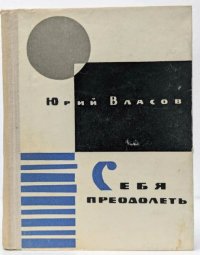
His first book, “Overcoming Oneself”, was published in 1964. After retiring from sport and military service in 1968, he became a professional writer. His later works include “The White Moment” (1972), “Salty Joys” (1976), and “The Special Region of China: 1942–1945” (1973), published under his father’s pseudonym. His monumental three-volume work “The Fiery Cross” is described by the author as a “historical confession.”
Public and Political Activity

From 1985 to 1987, Vlasov served as President of the USSR Weightlifting Federation, and from 1987 to 1988 as President of the Bodybuilding Federation. After bodybuilding was officially recognized as a sport in the USSR in 1987, Vlasov became the first president of the newly established federation.
From 1989 to 1991, he was a People’s Deputy of the USSR, openly criticizing the CPSU and the KGB. He later served as a Deputy of the State Duma (1993–1995), worked on the Security Committee, and ran for President of Russia in 1996.
He withdrew from political life after the election and passed away on February 13, 2021, in Moscow.

Born on December 5, 1935, in Makeevka, Donetsk Region — died on February 13, 2021, in Moscow.
Yury Petrovich Vlasov was a Soviet weightlifter, Olympic champion (1960), four-time World Champion (1959, 1961, 1962, 1963), and six-time European Champion (1959–1964). He was awarded the title of Honored Master of Sports of the USSR in 1959. Vlasov served as the flag bearer of the Soviet delegation at the opening ceremonies of the Olympic Games in 1960 and 1964. He was also a writer, public and political figure, a People’s Deputy of the USSR (1989–1991), and a Deputy of the State Duma of the Russian Federation (1993–1995).
Early Life and Education
Yury Vlasov was born on December 5, 1935, in Makeevka, Donetsk Region.
His father, Pyotr Parfenovich Vlasov (also known as Vladimirov) (1905–1953), was an intelligence officer, journalist, and diplomat, a specialist on China. His mother, Maria Danilovna Vlasova (died in 1987), was a native of the Kuban region and worked as a library director.
His childhood fell during the years of World War II. In 1943, at the age of eight, he lost his hair due to starvation.

From an early age, he actively engaged in sports. In 1953, he graduated with honors from the Saratov Suvorov Military School. In 1959, he graduated from the Zhukovsky Air Force Engineering Academy in Moscow, specializing in aviation radio communications engineering. Upon graduation, he was commissioned as a Senior Lieutenant.
From 1960 to 1968, Vlasov served as a sports inspector at CSKA (Central Sports Club of the Army). In May 1968, he submitted a request for discharge from military service and was released with the rank of Captain.
Athletic Career
In the spring of 1957, Vlasov set his first USSR records in the snatch (144.5 kg) and the clean and jerk (183.0 kg), hookup leading with Alexey Medvedev at the time. In 1958, he placed third at the USSR Championship (total 470 kg), and by 1959 he had taken leadership in the heavyweight category. From then until the 1964 Olympic Games, he remained undefeated in competitions.
At the 1960 Olympic Games in Rome, Vlasov pressed 180 kg (matching American James Bradford, who later won silver), snatched 155 kg (outperforming his closest rivals by 5 kg), and clean and jerked 202.5 kg, achieving a total of 537.5 kg. Bradford lagged behind by 20 kg in the clean and jerk and by 25 kg in total.

Vlasov began his final lift after all competitors had finished. His first attempt of 185 kg secured Olympic gold and set a world record in the total (520 kg), surpassing the previous record held since 1955 by American Paul Anderson. The second attempt at 195 kg raised the world record total to 530 kg. The third attempt at 202.5 kg established a new world record, bringing the final total to 537.5 kg — exceeding both Anderson’s official (512.5 kg) and unofficial (533 kg) achievements from 1956.
Between 1959 and 1963, Vlasov’s main international rivals were American athletes, especially Norbert Schemansky. Despite his age (born in 1924), Schemansky twice took world records from Vlasov in the snatch (1961, 1962) and twice placed second at World Championships (1962, 1963). Their rivalry peaked at the 1962 World Championship, where Schemansky lost by only 2.5 kg, despite winning the press and the snatch.

At the 1964 Olympic Games in Tokyo, Vlasov was the favorite. His main rival was teammate Leonid Zhabotinsky, who had set world records in the snatch, clean and jerk, and total earlier that year (records which Vlasov later reclaimed). Zhabotinsky outweighed Vlasov (154.4 kg vs. 136.4 kg), so in case of equal results, Vlasov would have won.
Vlasov won the press with a world record of 197.5 kg, leading by 10 kg. In the snatch, he lifted 162.5 kg only on his third attempt, allowing Zhabotinsky to close the gap to 5 kg. Unexpectedly, Vlasov attempted a fourth, non-scoring lift, setting a world record at 172.5 kg.
In the clean and jerk, Zhabotinsky lifted 200 kg; Vlasov responded with 205 kg and then 210 kg. The bar was raised above the world record to 217.5 kg. Zhabotinsky failed his second attempt (many later believed intentionally), Vlasov failed his third, but Zhabotinsky succeeded on his final attempt and won Olympic gold.

After the Tokyo Games, Vlasov ceased intensive training but resumed in 1966 due to financial difficulties. On April 15, 1967, he set his final world record at the Moscow Championship. He officially retired from elite sport in 1968. Between 1957 and 1967, Vlasov set 31 world records and 41 USSR records.
Struggle with Illness
In 1960, during a competition in Lviv, Vlasov felt a crunch and sharp pain in his lower spine while attempting to hold a heavy weight. In the spring of 1964, he suffered a series of severe colds with high fever. By 1969, his weight dropped to 110 kg (from a competitive 136.4 kg).
By the late 1960s, he experienced cardiac arrhythmia, headaches, shortness of breath, fatigue, and dangerously low blood pressure. From 1970 onward, he suffered frequent influenza, bleeding gums, spinal pain, liver pain, and chills. Doctors diagnosed him with gallbladder inflammation in 1970.
In his writings, Vlasov concluded that the root cause of his illness was nervous system exhaustion and believed recovery required absolute faith in the treatment method. He experimented with cold hardening following the method of German pastor Sebastian Kneipp, fasting according to Paul Bragg’s diet, and other extreme measures — many of which worsened his condition.
On February 21, 1983, he was hospitalized with acute spinal pain. Surgeons removed an intervertebral disc and inserted a 20-centimeter stainless steel fixation plate. Doctors forbade him even to sit. Nevertheless, Vlasov gradually resumed training with dumbbells — first lying down, then sitting and standing — combined with psychological self-training.
In Vlasov’s book “The Justice of Strength”, there is a photograph of Arnold Schwarzenegger with the inscription:
“To my idol, Yury Vlasov. March 1988.”

Schwarzenegger explained that meeting Vlasov at the 1961 World Championship in Vienna inspired him to commit himself fiercely to training. That brief encounter with “the strongest man in the world” helped shape the future seven-time Mr. Olympia, film star, and politician.
Literary Work
Vlasov began publishing essays and short stories in 1959. In 1961, he won second prize in a national sports short story competition. At the 1962 World Championship, he also worked as a special correspondent for Izvestia newspaper.
His first book, “Overcoming Oneself”, was published in 1964. After retiring from sport and military service in 1968, he became a professional writer. His later works include “The White Moment” (1972), “Salty Joys” (1976), and “The Special Region of China: 1942–1945” (1973), published under his father’s pseudonym. His monumental three-volume work “The Fiery Cross” is described by the author as a “historical confession.”
Public and Political Activity

From 1985 to 1987, Vlasov served as President of the USSR Weightlifting Federation, and from 1987 to 1988 as President of the Bodybuilding Federation. After bodybuilding was officially recognized as a sport in the USSR in 1987, Vlasov became the first president of the newly established federation.
From 1989 to 1991, he was a People’s Deputy of the USSR, openly criticizing the CPSU and the KGB. He later served as a Deputy of the State Duma (1993–1995), worked on the Security Committee, and ran for President of Russia in 1996.
He withdrew from political life after the election and passed away on February 13, 2021, in Moscow.
Attachments
-
 dg6sewV2EIsAunVGVW61vy_TL3S3cdjzhdr2TdINYB7g9MsHBhPgyYWDY-j7uGTDZrMOF5g0.jpg40.7 KB · Views: 26
 -
 RGUB-BIBL-0000186032-large.jpg116.3 KB · Views: 18
 -
 RGUB-BIBL-0000186032-large.jpg116.3 KB · Views: 19
 -
 Clipboard_02-04-2026_06.jpg88.1 KB · Views: 21
 -
 kqQ8vJAyOYuvqGKhD0qovf7QsHq5oGQ6uvZsHg1m0gGEndjdsPnRS66qQ_jTQzosjbVOSPxu.jpg156.7 KB · Views: 19
 -
 uE6slbUeQ7WDZwVR0hCp9r3e_NZakskFwvQXHgI6g_qB3rW_Qe2scZ-ZV6yhYJcghQrPdhHM.jpg233.7 KB · Views: 18
 -
 5vZqyXm4SSVDZRtrdJBdGqn8d8YfXIlSgCbhnYnMQPs1O4Sn_qTWU5ieg6YhU_H5beuGQTzzAT6wUabxdWxeKVY2.jpg208.9 KB · Views: 20
 -
 J49xal6Z7lS6wNQsI6HLVpmf6OFTsifyNACR7jI4PZvoNZFBjgs6hcqDmB6TpYvtC85o5iFNfQgFYetAzk-Pg92x.jpg75.8 KB · Views: 20