- Thread starter
- #581

Frimen1917
Mecca V.I.P.
VIP
- Joined
- Jan 9, 2026
- Messages
- 3,161
- Points
- 63
18 мая 1991 года подданная Великобритании Хелен Патрисия Шармен в составе девятой экспедиции совершила космический полёт на орбитальную станцию «Мир» на космическом корабле «Союз ТМ-12» вместе с Анатолием Арцебарским и Сергеем Крикалёвым.
А. Арцебарский и С. Крикалёв, как экипаж 9-й основной экспедиции на Орбитальную Станцию «Мир», заменили экипаж 8-й основной экспедиции (В. Афанасьев — М. Манаров). Британская женщина-космонавт Шармен провела на станции одну неделю. Её полёт был спонсирован частной британской компанией. Шармен осуществила на орбите биологические и химические эксперименты, а также провела для английских школ серию уроков.
Программа девятой основной экспедиции состояла из экспериментов по астрономии, биологии, химии, наблюдению Земли, космической технике, материаловедению и медицине. Помимо этого космонавты провели профилактические работы и заменили многие приборы. Во время работ в открытом космосе произведён ремонт антенны системы автоматического сближения «Курс» на модуле «Квант», смонтирована складывающаяся решетчатая мачта из нового никель-титанового сплава, предназначенная для установки дополнительного прибора управления на модуле «Квант».
За шесть выходов в открытый космос космонавты провели вне станции в общей сложности 32 ч 23 мин. Сергей Крикалёв пробыл на орбите на шесть месяцев дольше первоначально запланированного срока, так как две последующие миссии на «Мир» сокращены по финансовым причинам и позволяли заменить на орбите только одного члена основного экипажа. Провиант и расходные материалы доставлялись транспортными кораблями «Прогресс М-8» и «М-9».
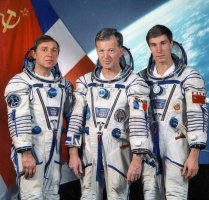
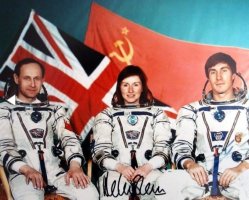
На фото слева направо: Анатолий Арцебарский, Хелен Шармен, Сергей Крикалев.
On May 18, 1991, British citizen Helen Patricia Sharman took part in a spaceflight as a member of the ninth expedition, traveling to the orbital station Mir aboard the spacecraft Soyuz TM-12 together with Anatoly Artsebarsky and Sergey Krikalev.
A. Artsebarsky and S. Krikalev, as the crew of the 9th principal expedition to the Mir Orbital Station, replaced the crew of the 8th principal expedition (V. Afanasyev and M. Manarov). British cosmonaut Helen Sharman spent one week aboard the station. Her flight was sponsored by a private British company. While in orbit, Sharman conducted biological and chemical experiments and also delivered a series of lessons for schools in the United Kingdom.
The program of the 9th principal expedition included experiments in astronomy, biology, chemistry, Earth observation, space engineering, materials science, and medicine. In addition, the cosmonauts carried out maintenance work and replaced numerous instruments. During spacewalks, they repaired the antenna of the Kurs automatic rendezvous system on the Kvant module and installed a collapsible lattice mast made of a new nickel-titanium alloy. The mast was intended for mounting an additional control instrument on the Kvant module.
Over the course of six spacewalks, the cosmonauts spent a total of 32 hours and 23 minutes outside the station. Sergey Krikalev remained in orbit six months longer than originally planned because the next two missions to Mir were reduced for financial reasons and allowed the replacement of only one member of the main crew. Food supplies and consumable materials were delivered by the cargo spacecraft Progress M-8 and Progress M-9.
In the photograph, from left to right: Anatoly Artsebarsky, Helen Sharman, and Sergey Krikalev.
El 18 de mayo de 1991, la ciudadana británica Helen Patricia Sharman realizó un vuelo espacial como integrante de la novena expedición a la estación orbital Mir, a bordo de la nave espacial Soyuz TM-12, junto con Anatoli Artsebarski y Serguéi Krikaliov.
A. Artsebarski y S. Krikaliov, como tripulación de la 9.ª expedición principal a la estación orbital Mir, sustituyeron a la tripulación de la 8.ª expedición principal (V. Afanásiev y M. Manárov). La cosmonauta británica Helen Sharman permaneció una semana en la estación. Su vuelo fue patrocinado por una empresa privada británica. Durante su estancia en órbita, Sharman realizó experimentos biológicos y químicos, además de impartir una serie de lecciones para escuelas del Reino Unido.
El programa de la 9.ª expedición principal incluyó experimentos de astronomía, biología, química, observación de la Tierra, ingeniería espacial, ciencia de materiales y medicina. Además, los cosmonautas llevaron a cabo trabajos de mantenimiento y sustituyeron numerosos instrumentos. Durante las actividades extravehiculares, repararon la antena del sistema automático de acoplamiento Kurs en el módulo Kvant e instalaron un mástil reticular plegable fabricado con una nueva aleación de níquel y titanio. Este mástil estaba destinado a la instalación de un instrumento de control adicional en el módulo Kvant.
A lo largo de seis salidas al espacio abierto, los cosmonautas pasaron un total de 32 horas y 23 minutos fuera de la estación. Serguéi Krikaliov permaneció en órbita seis meses más de lo previsto inicialmente, ya que las dos misiones siguientes a Mir fueron reducidas por motivos financieros y permitían sustituir únicamente a un miembro de la tripulación principal. Los víveres y materiales consumibles fueron suministrados por las naves de carga Progress M-8 y Progress M-9.
En la fotografía, de izquierda a derecha: Anatoli Artsebarski, Helen Sharman y Serguéi Krikaliov.
А. Арцебарский и С. Крикалёв, как экипаж 9-й основной экспедиции на Орбитальную Станцию «Мир», заменили экипаж 8-й основной экспедиции (В. Афанасьев — М. Манаров). Британская женщина-космонавт Шармен провела на станции одну неделю. Её полёт был спонсирован частной британской компанией. Шармен осуществила на орбите биологические и химические эксперименты, а также провела для английских школ серию уроков.
Программа девятой основной экспедиции состояла из экспериментов по астрономии, биологии, химии, наблюдению Земли, космической технике, материаловедению и медицине. Помимо этого космонавты провели профилактические работы и заменили многие приборы. Во время работ в открытом космосе произведён ремонт антенны системы автоматического сближения «Курс» на модуле «Квант», смонтирована складывающаяся решетчатая мачта из нового никель-титанового сплава, предназначенная для установки дополнительного прибора управления на модуле «Квант».
За шесть выходов в открытый космос космонавты провели вне станции в общей сложности 32 ч 23 мин. Сергей Крикалёв пробыл на орбите на шесть месяцев дольше первоначально запланированного срока, так как две последующие миссии на «Мир» сокращены по финансовым причинам и позволяли заменить на орбите только одного члена основного экипажа. Провиант и расходные материалы доставлялись транспортными кораблями «Прогресс М-8» и «М-9».
На фото слева направо: Анатолий Арцебарский, Хелен Шармен, Сергей Крикалев.
On May 18, 1991, British citizen Helen Patricia Sharman took part in a spaceflight as a member of the ninth expedition, traveling to the orbital station Mir aboard the spacecraft Soyuz TM-12 together with Anatoly Artsebarsky and Sergey Krikalev.
A. Artsebarsky and S. Krikalev, as the crew of the 9th principal expedition to the Mir Orbital Station, replaced the crew of the 8th principal expedition (V. Afanasyev and M. Manarov). British cosmonaut Helen Sharman spent one week aboard the station. Her flight was sponsored by a private British company. While in orbit, Sharman conducted biological and chemical experiments and also delivered a series of lessons for schools in the United Kingdom.
The program of the 9th principal expedition included experiments in astronomy, biology, chemistry, Earth observation, space engineering, materials science, and medicine. In addition, the cosmonauts carried out maintenance work and replaced numerous instruments. During spacewalks, they repaired the antenna of the Kurs automatic rendezvous system on the Kvant module and installed a collapsible lattice mast made of a new nickel-titanium alloy. The mast was intended for mounting an additional control instrument on the Kvant module.
Over the course of six spacewalks, the cosmonauts spent a total of 32 hours and 23 minutes outside the station. Sergey Krikalev remained in orbit six months longer than originally planned because the next two missions to Mir were reduced for financial reasons and allowed the replacement of only one member of the main crew. Food supplies and consumable materials were delivered by the cargo spacecraft Progress M-8 and Progress M-9.
In the photograph, from left to right: Anatoly Artsebarsky, Helen Sharman, and Sergey Krikalev.
El 18 de mayo de 1991, la ciudadana británica Helen Patricia Sharman realizó un vuelo espacial como integrante de la novena expedición a la estación orbital Mir, a bordo de la nave espacial Soyuz TM-12, junto con Anatoli Artsebarski y Serguéi Krikaliov.
A. Artsebarski y S. Krikaliov, como tripulación de la 9.ª expedición principal a la estación orbital Mir, sustituyeron a la tripulación de la 8.ª expedición principal (V. Afanásiev y M. Manárov). La cosmonauta británica Helen Sharman permaneció una semana en la estación. Su vuelo fue patrocinado por una empresa privada británica. Durante su estancia en órbita, Sharman realizó experimentos biológicos y químicos, además de impartir una serie de lecciones para escuelas del Reino Unido.
El programa de la 9.ª expedición principal incluyó experimentos de astronomía, biología, química, observación de la Tierra, ingeniería espacial, ciencia de materiales y medicina. Además, los cosmonautas llevaron a cabo trabajos de mantenimiento y sustituyeron numerosos instrumentos. Durante las actividades extravehiculares, repararon la antena del sistema automático de acoplamiento Kurs en el módulo Kvant e instalaron un mástil reticular plegable fabricado con una nueva aleación de níquel y titanio. Este mástil estaba destinado a la instalación de un instrumento de control adicional en el módulo Kvant.
A lo largo de seis salidas al espacio abierto, los cosmonautas pasaron un total de 32 horas y 23 minutos fuera de la estación. Serguéi Krikaliov permaneció en órbita seis meses más de lo previsto inicialmente, ya que las dos misiones siguientes a Mir fueron reducidas por motivos financieros y permitían sustituir únicamente a un miembro de la tripulación principal. Los víveres y materiales consumibles fueron suministrados por las naves de carga Progress M-8 y Progress M-9.
En la fotografía, de izquierda a derecha: Anatoli Artsebarski, Helen Sharman y Serguéi Krikaliov.