• Legal Notice – MuscleMecca Forums

    MuscleMecca.com is an educational discussion platform. We do not sell, promote, or endorse any bodybuilding gear, supplements, research chemicals, or performance-enhancing substances.

    All discussions are for educational and informational purposes only. Nothing posted on this forum should be considered medical or legal advice.

    Do not attempt to sell, source, or promote illegal substances. Any such activity will result in an immediate and permanent ban and may be reported to the proper authorities.

    By using this site, you agree to comply with all forum rules, disclaimers, and applicable laws in your jurisdiction.

    Read Our Full Disclaimer and Forum Rules

History of Soviet cosmonautics.

Frimen1917

Frimen1917

Mecca V.I.P.
VIP
Joined
Jan 9, 2026
Messages
3,202
Points
63
А. Соколов
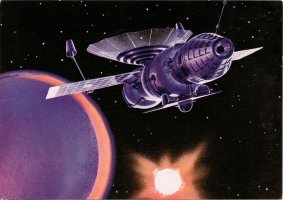
„Венера-4“ в полете
Заканчивается многодневный перелет. Автоматическая станция „Венера-4“ уже захвачена полем тяготения Венеры. Еще недолго — и отделится спускаемый отсек, начнется посадка на поверхность планеты.
A. Sokolov

“Venus-4” in flight
Many days of flight are coming to an end. Automatic station “Venus-4” is within the gravitation field of the Venus. Another moment and the separated section will begin landing to the surface of the planet.
A. Sokolov

«Venera-4» en vuelo
Está terminando el vuelo de muchos días. La estación automática «Venera-4» ya ha sido capturada por el campo gravitatorio de Venus. Dentro de poco se separará el módulo de descenso y comenzará el aterrizaje en la superficie del planeta.
318509 13
 
Frimen1917

Frimen1917

Mecca V.I.P.
VIP
Joined
Jan 9, 2026
Messages
3,202
Points
63
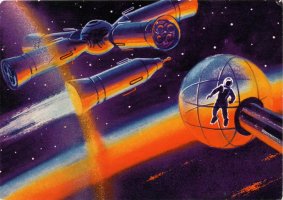
А. Леонов, А. Соколов
Сборка орбитальной станции
Одной из ближайших задач в освоении космоса, является строительство крупных орбитальных станций — космических лабораторий. Может быть это строительство будет осуществляться автоматически, человек будет только наблюдать за ним?
A. Leonov, A. Sokolov

Assembling of an orbital station
One of the nearest tasks in space exploration is the construction of large orbital stations — space laboratories. Can it be so that such construction will be automatic and man will be just a supervisor?
A. Leonov, A. Sokolov

Montaje de una estación orbital
Una de las tareas más próximas en la exploración del espacio es la construcción de grandes estaciones orbitales — laboratorios espaciales. ¿Puede ser que esta construcción se realice de forma automática y el hombre sea solo un supervisor?
318509 15
 
Frimen1917

Frimen1917

Mecca V.I.P.
VIP
Joined
Jan 9, 2026
Messages
3,202
Points
63
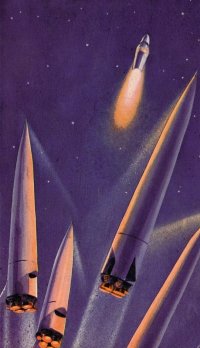
А. Леонов, А. Соколов
Старт космического корабля „Восток“
Один из этапов старта: сброшены отработавшие двигатели первой ступени ракеты-носителя.
A. Leonov, A. Sokolov

Launching of space ship “Vostok”
One of the stages of launching: used boosters of the first stage are dropped down.
A. Leonov, A. Sokolov

Lanzamiento de la nave espacial «Vostok»
Una de las etapas del lanzamiento: se desprenden los motores ya usados de la primera etapa del cohete portador.
318509 17
 
Frimen1917

Frimen1917

Mecca V.I.P.
VIP
Joined
Jan 9, 2026
Messages
3,202
Points
63
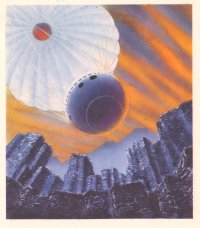
А. Соколов
Под куполом парашюта
Погасив космическую скорость, открылся парашют. Плавно опускаясь, автоматическая станция непрерывно ведёт радиопередачу, сообщая на Землю результаты измерений температуры, плотности, состава атмосферы Венеры.
A. Sokolov

Under the parachute
The landing station while smoothly landing is continuously broadcasting to the Earth results of measuring temperature, density and composition of the Venus atmosphere.
A. Sokolov

Bajo el dosel del paracaídas
Tras frenar la velocidad cósmica, se abrió el paracaídas. Descendiendo suavemente, la estación automática transmite continuamente por radio a la Tierra los resultados de las mediciones de temperatura, densidad y composición de la atmósfera de Venus.
 
Frimen1917

Frimen1917

Mecca V.I.P.
VIP
Joined
Jan 9, 2026
Messages
3,202
Points
63
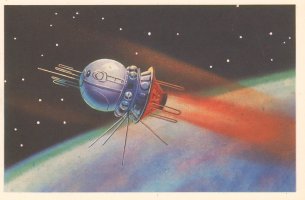
А. Леонов, А. Соколов
„Восток“ идёт домой
Заканчивается полёт по орбите. Включены тормозные установки, гасится космическая скорость. Скоро корабль войдёт в плотные слои атмосферы.
A. Leonov, A. Sokolov

“Vostok” is returning home
The flight on the orbit is coming to an end, the brakes are turned on, cosmic speed is reduced, very soon the ship will enter thick layers of the atmosphere.
A. Leonov, A. Sokolov

«Vostok» regresa a casa
El vuelo en órbita está terminando. Se han activado los motores de frenado, se reduce la velocidad cósmica. Pronto la nave entrará en las capas densas de la atmósfera.
 
Frimen1917

Frimen1917

Mecca V.I.P.
VIP
Joined
Jan 9, 2026
Messages
3,202
Points
63
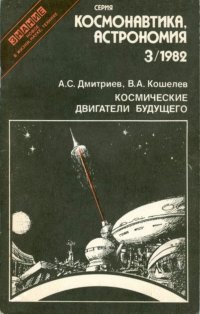
"Многочисленные полеты автоматических станций к Венере, Марсу и дальним планетам Солнечной системы создали впечатление, что это задача скорее сегодняшнего, чем завтрашнего дня. Во всяком случае, пилотируемые полеты к Марсу и Венере давно перестали быть объектом научно-фантастической литературы. Вместе с тем возможное решение этих задач в рамках современной технологии, т. е. с использованием только ЖРД, представляется крайне громоздким и чрезвычайна дорогим. Один из самых «скромных» вариантов экспедиции на Марс предусматривает при полезной нагрузке межпланетного корабля 50 т выведение на низкую орбиту элементов конструкции корабля и топлива общей массой 500 – 700 т пятью – семью пусками ракет типа «Сатурн-5».

Но пугает не сама начальная масса, а необходимость проведения большого объема сложных монтажных работ в космосе. Выведение же совокупного полезного груза массой 500 – 1000 т, как уже отмечалось, будет ординарной задачей для ведущих космических держав уже к концу 80-х годов. Следует отметить, что для решения задачи полета к Марсу с помощью электрореактивных двигателей малой тяги и ЯЭУ или при использовании твердофазного ядерного реактора со скоростью истечения около 9 км/с общая выводимая на опорную орбиту масса составит 150 – 200 т. Продолжительность марсианской экспедиции во всех случаях примерно одинакова – 2 года 8 месяцев.

Уменьшение продолжительности экспедиции в 2 раза потребует увеличения энергетических затрат на порядок. В то же время уменьшение срока экспедиций к планетам весьма желательно. Здесь открываются широкие перспективы перед двигателями с высокими энергетическими показателями, в частности, газофазными ядерными двигателями, термоядерными и импульсными термоядерными двигателями. Нетрудно видеть, что речь здесь идет о двигателях, проблема создания которых на грани современных технологических возможностей. В связи с этим, во всяком случае на первых этапах пилотируемых межпланетных полетов, значительный выигрыш может быть достигнут за счет применения двигателей с использованием внешних источников электромагнитного излучения в качестве двигателей большой тяги при старте с орбиты ИСЗ".(А.С.Дмитриев, В.А.Кошелев.
"Космические двигатели будущего").
...................................................................
Цит.по: Александр Сергеевич Дмитриев,
Владимир Алексеевич Кошелев
КОСМИЧЕСКИЕ ДВИГАТЕЛИ БУДУЩЕГО
Серия «Космонавтика, астрономия»
НОВОЕ В ЖИЗНИ, НАУКЕ, ТЕХНИКЕ
№ 3, 1982 г.
На фото обложка художника В. Н. Конюхова.
ИЗДАТЕЛЬСТВО «ЗНАНИЕ»

Москва 1982 год

Numerous flights of automatic stations to Venus, Mars and the distant planets of the Solar System have created the impression that this is a task of today rather than of tomorrow. In any case, manned flights to Mars and Venus have long ceased to be the object of science-fiction literature. At the same time, a possible solution of these tasks within the framework of modern technology, i.e. with the use of chemical rocket engines only, appears extremely cumbersome and extraordinarily expensive. One of the most “modest” variants of an expedition to Mars provides, with a useful load of the interplanetary ship of 50 t, for the launching into low orbit of structural elements of the ship and propellant with a total mass of 500–700 t by five to seven launches of rockets of the “Saturn-5” type.


What is alarming is not the initial mass itself, but the necessity of carrying out a large volume of complex assembly work in space. The launching of a total useful load of 500–1000 t, as already noted, will be an ordinary task for the leading space powers already by the end of the 1980s. It should be noted that for the solution of the task of a flight to Mars with the help of electric rocket engines of low thrust and a nuclear power plant, or with the use of a solid-phase nuclear reactor with an exhaust velocity of about 9 km/s, the total mass to be launched into the reference orbit will amount to 150–200 t. The duration of a Martian expedition is in all cases approximately the same — 2 years 8 months.

A reduction of the duration of the expedition by a factor of two will require an increase of the energy expenditure by an order of magnitude. At the same time a reduction of the duration of expeditions to the planets is highly desirable. Here wide prospects open up before engines with high energy characteristics, in particular gas-phase nuclear engines, thermonuclear and pulsed thermonuclear engines. It is not difficult to see that here we are speaking of engines the problem of whose creation is on the verge of modern technological possibilities. In this connection, at least at the first stages of manned interplanetary flights, a considerable gain can be achieved by the application of engines using external sources of electromagnetic radiation as engines of high thrust for the start from the orbit of an artificial Earth satellite.

(A. S. Dmitriev, V. A. Koshelev. “Space Engines of the Future”).

...................................................................

Quoted from: Aleksandr Sergeyevich Dmitriev,
Vladimir Alekseyevich Koshelev
SPACE ENGINES OF THE FUTURE
Series “Cosmonautics, Astronomy”
NEW IN LIFE, SCIENCE, TECHNOLOGY
No. 3, 1982
On the photo — cover by the artist V. N. Konyukhov.
PUBLISHING HOUSE “ZNANIYE”

Moscow 1982
Numerosos vuelos de estaciones automáticas a Venus, Marte y los planetas lejanos del Sistema Solar han creado la impresión de que esta es una tarea de hoy más que de mañana. En cualquier caso, los vuelos tripulados a Marte y Venus hace tiempo que dejaron de ser objeto de la literatura de ciencia ficción. Al mismo tiempo, una posible solución de estas tareas en el marco de la tecnología moderna, es decir, con el uso únicamente de motores cohete químicos, parece extremadamente engorrosa y extraordinariamente costosa. Una de las variantes más «modestas» de una expedición a Marte prevé, con una carga útil de la nave interplanetaria de 50 t, la puesta en órbita baja de los elementos estructurales de la nave y del propelente con una masa total de 500–700 t mediante cinco a siete lanzamientos de cohetes del tipo «Saturno-5».


Lo que asusta no es la masa inicial en sí, sino la necesidad de realizar un gran volumen de complejos trabajos de montaje en el espacio. La puesta en órbita de una carga útil total de 500–1000 t, como ya se ha señalado, será una tarea ordinaria para las principales potencias espaciales ya hacia finales de los años 80. Cabe señalar que para la solución de la tarea del vuelo a Marte con ayuda de motores cohete eléctricos de baja empuje y una planta de energía nuclear, o con el uso de un reactor nuclear de fase sólida con una velocidad de escape de unos 9 km/s, la masa total que debe ponerse en la órbita de referencia será de 150–200 t. La duración de una expedición marciana es en todos los casos aproximadamente la misma: 2 años y 8 meses.

La reducción de la duración de la expedición a la mitad exigirá un aumento del gasto energético en un orden de magnitud. Al mismo tiempo, la reducción de la duración de las expediciones a los planetas es muy deseable. Aquí se abren amplias perspectivas ante los motores con altos indicadores energéticos, en particular los motores nucleares de fase gaseosa, los termonucleares y los termonucleares de impulsos. No es difícil ver que aquí se trata de motores cuya creación está en el límite de las posibilidades tecnológicas modernas. En este sentido, al menos en las primeras etapas de los vuelos interplanetarios tripulados, se puede lograr una ganancia considerable mediante la aplicación de motores que utilizan fuentes externas de radiación electromagnética como motores de gran empuje para el despegue desde la órbita de un satélite artificial de la Tierra.

(A. S. Dmitriev, V. A. Koshelev. “Motores espaciales del futuro”).

...................................................................

Citado de: Aleksandr Serguéyevich Dmitriev,
Vladímir Alekséyevich Koshelev
MOTORES ESPACIALES DEL FUTURO
Serie «Cosmonáutica, Astronomía»
NUEVO EN LA VIDA, LA CIENCIA, LA TÉCNICA
N.º 3, 1982
En la foto — portada del artista V. N. Konyujov.
EDITORIAL «ZNÁNIYE»

Moscú 1982
GBm6hcIJgh24yG36MhT3XvkLuac76DfARHbHev3wu5oOZDJPbq bkcWtgx 0cH5tWLlwweWDpTEl23iSt7bEy5RK
 
Frimen1917

Frimen1917

Mecca V.I.P.
VIP
Joined
Jan 9, 2026
Messages
3,202
Points
63
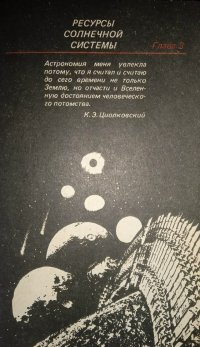
"Обширное околосолнечное пространство дает возможность выбора различных рациональных путей и форм использования сырьевых и энергетических ресурсов Солнечной системы, а следовательно, и успешного перспективного развития человечетства. В связи с этим полезно вспомнить высказывание академика Е.К.Федорова, показывающее, в частности, высокую эффективность освоения внеземных природных богатств: "По мере дальнейшего научно-технического прогресса ...человечество сумеет производить все из всего. То есть можно полагать, что общее количество вещества и энергии, доступных для использования, станет в перспективе единой и универсальной мерой природных ресурсов". К аналогичному выводу приходит и английский ученый Артур Кларк, который, однако, подчеркивает важность разумных взаимноотношений в человеческом обществе: " Из сделанного обзора вполне явствует, что прогрессирующее истощение сырьевых ресурсов нам не угрожает. В этой невообразимо огромной Вселенной мы никогда не будем страдать от нехватки энергии или материи. Надо только не забывать о другой опасности, что нам может не хватить ума".
(А.Т. Улубеков. "Богатство внеземных ресурсов"; глава 3. "Ресурсы Солнечной системы").
........................................................................................................................
Цит.по: Аркадий Тигранович Улубеков
БОГАТСТВА ВНЕЗЕМНЫХ РЕСУРСОВ
Москва/ Издательство "Знание"/ 1984 год

На фото рисунок художника Н.В. Пьяных к третьей главе книги "Ресурсы солнечной системы". На рисунке цитата К.Э.Циолковского: "Астрономия меня увлекла потому, что я считал и считаю до сего времени не только Землю, но отчасти и Вселенную достоянием человеческого потомства".
The vast circumsolar space provides the opportunity to choose various rational ways and forms of utilizing the raw-material and energy resources of the Solar System and, consequently, of the successful long-term development of mankind. In this connection it is useful to recall the statement of Academician E. K. Fyodorov, which demonstrates, in particular, the high efficiency of mastering extraterrestrial natural riches: “As scientific and technical progress continues … mankind will be able to produce everything from everything. That is, one may assume that the total quantity of matter and energy available for use will in the long run become a single and universal measure of natural resources.” A similar conclusion is reached by the English scientist Arthur Clarke, who, however, emphasizes the importance of reasonable mutual relations in human society: “From the survey that has been made it is quite clear that progressive exhaustion of raw-material resources does not threaten us. In this unimaginably vast Universe we shall never suffer from a shortage of energy or matter. We must only not forget the other danger — that we may not have enough intelligence.”


(A. T. Ulubekov. “The Wealth of Extraterrestrial Resources”; Chapter 3. “Resources of the Solar System”).

........................................................................................................................

Quoted from: Arkady Tigranovich Ulubekov
THE WEALTH OF EXTRATERRESTRIAL RESOURCES
Moscow / Publishing House “Znaniye” / 1984

On the photo — a drawing by the artist N. V. Pyanykh for the third chapter of the book “Resources of the Solar System”. On the drawing is a quotation of K. E. Tsiolkovsky: “Astronomy captivated me because I considered and still consider not only the Earth, but partly also the Universe to be the heritage of human posterity.”

El vasto espacio circumsolar ofrece la posibilidad de elegir diversas vías y formas racionales de utilización de los recursos de materias primas y energéticos del Sistema Solar y, por consiguiente, del exitoso desarrollo a largo plazo de la humanidad. En este sentido es útil recordar la afirmación del académico E. K. Fiódorov, que muestra, en particular, la alta eficacia de la explotación de las riquezas naturales extraterrestres: «A medida que progrese el avance científico-técnico … la humanidad sabrá producir todo a partir de todo. Es decir, puede considerarse que la cantidad total de materia y energía disponibles para su uso se convertirá en el futuro en una medida única y universal de los recursos naturales». A una conclusión análoga llega también el científico inglés Arthur Clarke, quien, sin embargo, subraya la importancia de las relaciones mutuas razonables en la sociedad humana: «Del examen realizado se desprende con toda claridad que el agotamiento progresivo de los recursos de materias primas no nos amenaza. En este universo inimaginablemente vasto nunca padeceremos escasez de energía ni de materia. Solo hay que no olvidar el otro peligro: que podamos no tener suficiente inteligencia».


(A. T. Ulubekov. “La riqueza de los recursos extraterrestres”; Capítulo 3. “Recursos del Sistema Solar”).

........................................................................................................................

Citado de: Arkadí Tigránovich Ulubekov
LAS RIQUEZAS DE LOS RECURSOS EXTRATERRESTRES
Moscú / Editorial “Znaniye” / 1984

En la foto — un dibujo del artista N. V. Pianyj para el tercer capítulo del libro “Recursos del Sistema Solar”. En el dibujo aparece una cita de K. E. Tsiolkovski: «La astronomía me cautivó porque consideraba y sigo considerando hasta el día de hoy no solo la Tierra, sino en parte también el Universo, patrimonio de la posteridad humana».
JCDH XJDd A x6UAfpy8Uu9 yRI4vYdv4wXGQGY9lopi990D434YkkPpXssR6nuS4fOIKRNvErZDa5CF0qoemDmSjUWLig
 
Frimen1917

Frimen1917

Mecca V.I.P.
VIP
Joined
Jan 9, 2026
Messages
3,202
Points
63
"Лётчик-космонавт СССР, дважды Герой Советского Союза Виталий Иванович Севастьянов со временем стал очень заметной фигурой в шахматном мире. В 1977 году он был избран председателем Шахматной федерации СССР и занимал этот пост до 1986 года, а потом, после небольшого перерыва, в 1988-1989 годах.

Виталий Севастьянов пользовался большим влиянием в шахматном мире — прославленный космонавт был членом ЦК ФИДЕ, почётным членом ФИДЕ, международным арбитром и даже сыграл заметную роль во время драматического матча 1978 года в Багио (Филиппины) между Анатолием Карповым и Виктором Корчным. В тот момент, когда Карпов проиграл на финише три партии из четырёх и счёт сравнялся, атмосфера в советской делегации была весьма тревожной. Срочно приехавший Севастьянов сумел поднять настроение: человек, профессия которого была связана с экстремальными ситуациями, умел это делать. Чтобы помочь Карпову преодолеть кризис, Севастьянов уговорил его совершить поездку на автомашине в Манилу, на финальный матч чемпионата мира по баскетболу между командами СССР и Югославии. И хотя советские баскетболисты проиграли, поездка полностью себя оправдала — в решающей партии Карпову удалось победить".(По материалам газеты «Советский спорт»).

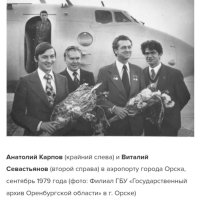
На фото: крайний слева легендарный чемпион мира по шахматам Анатолий Карпов, второй справа летчик-космонавт Виталий Севастьянов в аэропорту города Орска. Сентябрь 1979 года. Фото взято из филиала ГБУ "Государственный архив Оренбургской области в городе Орске.
Pilot-Cosmonaut of the USSR, twice Hero of the Soviet Union Vitaly Ivanovich Sevastyanov in time became a very prominent figure in the chess world. In 1977 he was elected Chairman of the Chess Federation of the USSR and held this post until 1986, and then, after a short break, in 1988–1989.


Vitaly Sevastyanov enjoyed great influence in the chess world — the celebrated cosmonaut was a member of the FIDE Central Committee, an Honorary Member of FIDE, an International Arbiter, and even played a notable role during the dramatic 1978 match in Baguio (Philippines) between Anatoly Karpov and Viktor Korchnoi. At the moment when Karpov lost three games out of four at the finish and the score became equal, the atmosphere in the Soviet delegation was rather anxious. Sevastyanov, who had urgently arrived, managed to raise spirits: a man whose profession was connected with extreme situations knew how to do this. In order to help Karpov overcome the crisis, Sevastyanov persuaded him to make a car trip to Manila, to the final match of the World Basketball Championship between the teams of the USSR and Yugoslavia. And although the Soviet basketball players lost, the trip fully justified itself — in the decisive game Karpov managed to win.

(Based on materials from the newspaper “Soviet Sport”).

On the photo: far left — the legendary World Chess Champion Anatoly Karpov, second from the right — Pilot-Cosmonaut Vitaly Sevastyanov at the airport of the city of Orsk. September 1979. Photo taken from the branch of the State Budgetary Institution “State Archive of the Orenburg Region in the city of Orsk”.

El piloto-cosmonauta de la URSS, dos veces Héroe de la Unión Soviética Vitali Ivánovich Sevastianov con el tiempo se convirtió en una figura muy destacada en el mundo del ajedrez. En 1977 fue elegido presidente de la Federación de Ajedrez de la URSS y ocupó este cargo hasta 1986, y después, tras un breve intervalo, en 1988–1989.


Vitali Sevastianov gozaba de gran influencia en el mundo del ajedrez: el célebre cosmonauta fue miembro del Comité Central de la FIDE, miembro de honor de la FIDE, árbitro internacional e incluso desempeñó un papel notable durante el dramático match de 1978 en Baguio (Filipinas) entre Anatoli Kárpov y Viktor Korchnói. En el momento en que Kárpov perdió tres partidas de cuatro en el final y el marcador se igualó, la atmósfera en la delegación soviética era bastante inquieta. Sevastianov, que había llegado urgentemente, logró levantar el ánimo: un hombre cuya profesión estaba relacionada con situaciones extremas sabía cómo hacerlo. Para ayudar a Kárpov a superar la crisis, Sevastianov le convenció de realizar un viaje en automóvil a Manila, al partido final del Campeonato Mundial de Baloncesto entre los equipos de la URSS y Yugoslavia. Y aunque los baloncestistas soviéticos perdieron, el viaje se justificó plenamente: en la partida decisiva Kárpov logró vencer.

(Según materiales del periódico «Deporte Soviético»).

En la foto: extremo izquierdo — el legendario campeón mundial de ajedrez Anatoli Kárpov, segundo por la derecha — el piloto-cosmonauta Vitali Sevastianov en el aeropuerto de la ciudad de Orsk. Septiembre de 1979. Foto tomada de la filial de la Institución Presupuestaria Estatal «Archivo Estatal de la Región de Orenburgo en la ciudad de Orsk».
VKLKFXODCaq2wKBKDncnJ75WMbMqQVeQIFh46aI3ZF3LeQGQmX0urwzYm6zf0cANOUj3h70nj2uK6457u6wTZwl59ZoqKA
 
Top